Note: This website was automatically translated, so some terms or nuances may not be completely accurate.
 Insight Memo [25/65]
Information Media Becoming Smart Platforms
〈 Publication Date: January 31, 2013 〉
 |
This Insight Memo, published to coincide with the 20th edition of the 'Information Media White Paper 2013', examines the concept of "smart" that has recently been making waves. 2012 was a year that significantly impacted consumers' information engagement behaviors, with smartphones and social media becoming widely adopted and promoting multi-screen viewing habits. This trend is likely to continue into 2013 and beyond, alongside the proliferation of smartphones and tablets. Meanwhile, signs point to the widespread adoption of "smartification" trends across the information media industry, offering hints for creating new industries and expanding markets.
(1) The Information Media Industry: A Path of Expansion and Diversification
Postwar industries related to information media were heavily weighted toward newspapers, radio, and film. Today, however, information media itself has diversified, creating an environment where information can be obtained from a vast number of sources. Particularly with the proliferation of mobile phones and, more recently, smartphones, consumers now have access to information in a wide variety of settings.
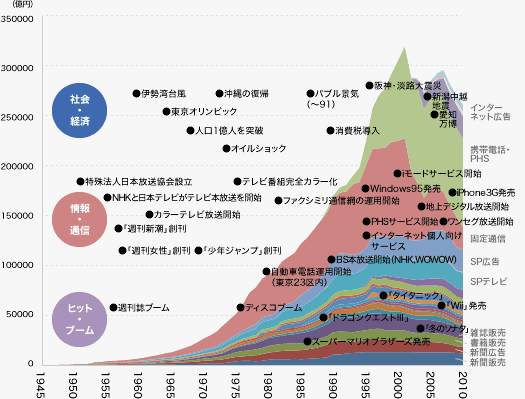
However, on the other hand, the information media market itself tends to shrink during economic downturns, such as the collapse of the IT bubble in 2001 and the Lehman Shock in 2008. This characteristic reveals a certain vulnerability to events negatively impacting the economy (see chart). Indeed, from the perspective of consumer spending on information media, it peaked in 2000, declined thereafter, rose again between 2003 and 2006, and has been declining once more since 2007 (Source: Ministry of Internal Affairs and Communications, "Annual Report on Household Expenditures: Household Income and Expenditure").
The Trajectory of the Expanding Information Media Industry
(2) Signs of Smartification
DENTSU SOKEN INC. predicts that 'smart' will be the keyword for the information media industry in 2013. The much-discussed "big data" is no exception. While it involves extracting consumer behavior and preference patterns from vast amounts of information for marketing purposes, technological improvements are still needed. The stage where human-centric qualitative interpretation is added—delivering messages and recommendations from companies tailored to each individual consumer's mood—is still ahead.
We will likely see many attempts to efficiently create unprecedented added value by open-sourcing the various data held by companies and leveraging the experience and know-how of the players gathered there. Regarding the product/service called "smart TV," this year will be one where market players explore what makes a TV smart for consumers. Going forward, trial and error to create marketability for smart TVs, including operability and usability, will likely continue.
(3) What is True Smart?
The concept of "smart" has two aspects: "quantitative smart" and "qualitative smart." From the perspective of the former, "quantitative smart," recent trends include the widespread quantification and analysis of text data on social media. Simultaneously, integrating and analyzing big data alongside various marketing data to enhance business intelligence is an effective evolutionary direction, ultimately leading to new discoveries and further added value. The latter, "qualitative smart," refers to smartness judged against criteria rooted in human sensibilities and intuition, not based on quantitative data.
True smartness will likely be realized by combining these two elements. The trend toward smartification shows no signs of stopping—smart devices, smart usage, smart lifestyles, smart cities, smart mobility, smart home appliances, and more. We anticipate that innovations once unimaginable will enrich consumers' lives.
Was this article helpful?
Share this article


Newsletter registration is here
We select and publish important news every day
For inquiries about this article
Back Numbers
Author

dentsu Media Innovation Lab
Dentsu Inc.
Insight MemoSpecial Discussion: "Japan's Advertising Expenditures"Explore the Amazing World of YouTube Creators with UUUMInformation Media White Paper 2024: The Rapidly Changing Media Environment and Consumers100 years since its birth. Radio, today...College Students and the Future of Media, Communication, and Advertising in Ten YearsInformation Media White Paper 2025: New Horizons in Communication Shaping the FutureInformation Media White Paper Special Report 2026: “The Current State of Evolving Information Trends”