Note: This website was automatically translated, so some terms or nuances may not be completely accurate.
 Insight Memo [26/65]
The Arrival of the Smartphone and Tablet Era and the Future of "Multitasking Viewing" on Television
〈 Publication Date: February 21, 2013 〉
■ Smartphone Use Expands "Multitasking Viewing" of TV
In recent years, internet use within the home has become commonplace. Particularly recently, smartphones and tablet devices, which are highly portable and well-suited for internet use, have become widespread. As a result, it is becoming increasingly possible to use the internet easily anywhere in the home.
Particular attention has been drawn to the spread of a new form of "simultaneous viewing": using smartphones or tablets to access the internet while watching TV in the living room, where the main household television is typically located.
Therefore, DENTSU SOKEN INC. selected the evening of Friday, September 7, 2012, to investigate how many people actually use the internet while watching TV and what devices they use. The survey results are presented below.
First, partly due to the survey's age limit of 49 years old and its online questionnaire format, approximately 20% of people watching TV during a specific time slot were also using the internet at the same time (line graph).
Simultaneous TV Viewing and Internet Use
(Average for September 7, 2012, 9:00 PM to 11:00 PM)

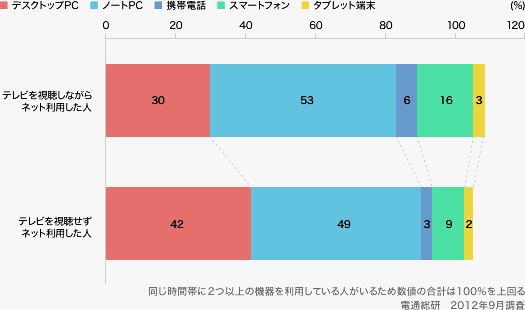
■ What devices were used for internet access during multitasking?
The next graph compares those who used the internet while watching TV (top) with those who used the internet without watching TV (bottom). Among simultaneous viewers, notebook PCs, smartphones, and non-smartphone mobile phones were most commonly used, with simple averages of 53%, 16%, and 6%, respectively. The rise in smartphone usage, despite its relatively short time on the market, is particularly notable. Conversely, desktop PC usage averaged only 30%, significantly lower. This suggests portable internet-connected devices are more compatible with TV viewing.
Devices Used While Accessing the Internet
(Average from 9:00 PM to 11:00 PM on September 7, 2012)
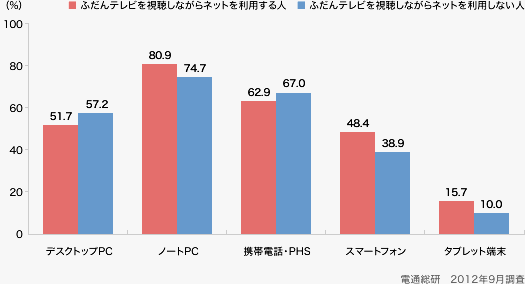
■ Differences in Internet Device Ownership Rates
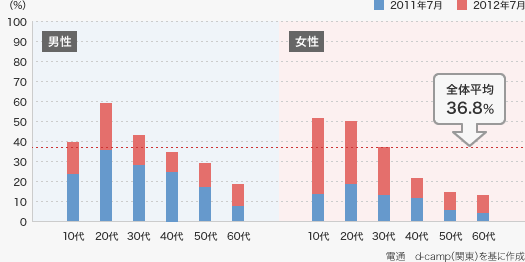
Interestingly, among those who reported regularly using the internet while watching TV, the ownership rates for laptops, smartphones, and tablets—devices with high usage rates—were themselves high, while desktop PC ownership rates were low.
Relationship between "multitasking" TV and internet use and device ownership rates
■ The chicken-and-egg relationship
Thus, behind the spread of multitasking between TV and the internet lies
(1) On one hand,
there is a tendency for ownership rates of smartphones and tablet devices—which are highly portable—to increase because people want to easily enjoy the internet even while watching TV,
(2) On the other hand,
there is also the aspect that owning such devices leads to a stronger tendency to use television and the internet simultaneously.
In other words, it could be described as a circular relationship, like the chicken and the egg.
Currently, phenomena like "second screen services"—which allow users to view related program or commercial information on a web screen while watching TV—and "social TV," where viewers share their thoughts on internet social media while watching, are gaining attention.
Looking ahead, with the continued proliferation and increasing sophistication of smartphones and tablet devices, it seems television viewing experiences hold significant potential for further evolution.
Was this article helpful?
Share this article


Newsletter registration is here
We select and publish important news every day
For inquiries about this article
Back Numbers
Author

dentsu Media Innovation Lab
Dentsu Inc.
Insight MemoSpecial Discussion: "Japan's Advertising Expenditures"Explore the Amazing World of YouTube Creators with UUUMInformation Media White Paper 2024: The Rapidly Changing Media Environment and Consumers100 years since its birth. Radio, today...College Students and the Future of Media, Communication, and Advertising in Ten YearsInformation Media White Paper 2025: New Horizons in Communication Shaping the FutureInformation Media White Paper Special Report 2026: “The Current State of Evolving Information Trends”