Note: This website was automatically translated, so some terms or nuances may not be completely accurate.
 Insight Memo [28/65]
The Future of Information Media Consumption: Examined Through the Affinity of Those in Their Late 20s to the Internet
〈 Publication Date: May 7, 2013 〉
■ Why "Arasa"?
The term "arasa" (around 30) has become firmly established in society, with virtually everyone having heard or used it at least once. This is because the term first came into use around 2006, meaning seven years have already passed since then.
Therefore, DENTSU SOKEN INC. conducted a new survey to explore the actual media consumption habits of today's 'arasa women.'
Below, we present the key findings from this survey.
■ Understanding the Lifestyle of Women in Their Late 20s to Early 30s
In this survey, to understand the true nature of the Arasa demographic, we asked several questions about lifestyle. Compared to other age groups, various characteristics unique to Arasa emerged.
First, "Free Time at Home After Waking Up." The free time after waking up at home for women in their late 20s/early 30s was the shortest compared to other age groups, at 204 minutes (about 3 hours and 20 minutes). This shows that women in their late 20s/early 30s lead busy daily lives. (Graph (1))
Regarding "monthly discretionary spending (excluding essential living expenses)," the figure was ¥24,116, the highest among all age groups, suggesting that those in their late 20s to early 30s enjoy a financially comfortable lifestyle. (Graph (2))
Looking at spending trends among financially comfortable people in their thirties, for example, the "monthly proportion spent on eating out" (Graph (3)) and the "monthly proportion spent on online shopping" (Graph (4)) show that most spend less than 10,000 yen per month. Despite having a high amount of disposable income, they do not tend to splurge.
[Graph 1]
Free time at home after waking up
(Time freely available at home after subtracting essential daily activities like sleep, meals, and bathing)

【 Graph 2 】
Monthly Disposable Pocket Money
(excluding necessary living expenses)

【 Graph 3 】
Percentage of Monthly Dining-Out Expenses by Age Group

【 Graph 4 】
Percentage of Each Age Group Spending Within Specific Monthly Online Shopping Amount Ranges

■ The Thirtysomethings: Down-to-Earth Innovators
As shown above, women in their late 20s/early 30s exhibit a relatively prudent consumption style, showing no tendency toward extravagance. However, examining the question, "Are they prudent and conservative in every aspect?" reveals another interesting point.
First, regarding the trend-sensitivity item "I'm interested in new or popular things that people pay attention to," about 60% (TOP2BOX) responded "applies to me," a higher result than other age groups. (Graph (5))
Furthermore, data shows that the proportion of people who "adopted them before they became a major trend" for actual booms like "eyelash extensions" and "nail care at nail salons" tends to be higher than in other age groups. This reveals that women in their thirties are actually a "grounded innovator group."
[Graph 5]
Interested in new things, trends, and what people are paying attention to

■ Those in their thirties are down-to-earth innovators in media consumption too
Next, regarding the thirtysomethings' media awareness: When asked "Which media do you use most to get reliable information about world events and trends?" (only one choice allowed), about 60% of the thirtysomething demographic answered "TV." Next was "Internet" at 24%, followed by "Newspaper" at 11.5%. A distinctive feature of the late twenties/early thirties age group compared to other age groups was the higher proportion of respondents selecting "Internet".
Looking further at what kind of information people in their late 20s to early 30s actually obtain and how they get it: for "The source where you most often get information about 'news'" (only one choice allowed), "TV" was 64%, "Information sites on mobile phones/smartphones" 25%, and "Websites on PCs" 7.5%. For "The source where you most often get information about 'weather forecasts'" (same conditions), "TV" was 54.5%, "mobile phone/smartphone information sites" at 36.5%, and "computer websites" at 6.5%. As expected, the trend showed a higher preference for internet-based sources compared to other age groups.
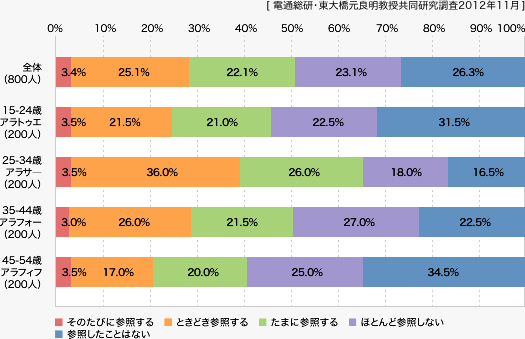
While high engagement with the internet was confirmed, regarding its usage, as seen in "Cooking while using recipe sites like 'COOKPAD' via the internet" (Graph (6)) and "When planning to eat out, sometimes checking review sites for restaurants" (Graph (7)), approximately 70% of those in their thirties responded affirmatively. This represents a higher proportion compared to other age groups. This group effectively utilizes online information in daily life, demonstrating high affinity with the internet and positioning them as innovators in media consumption patterns.
[Graph 6]
I sometimes cook while using recipe sites like "COOKPAD" via the internet on a PC, smartphone, or tablet

【 Graph 7 】
When planning to eat out, I sometimes check review sites for restaurants
(such as "Gurunavi" or "Tabelog")
■ The Evolution of Information Media Consumption Styles Seen Through the Eyes of Those in Their Late 20s to Early 30s
As explained above, people in their thirties show high affinity for the internet and are innovators in media consumption styles. This is likely influenced by the current lifestyle circumstances of this age group and the internet environment they experienced during their formative years.
Today's people in their late 20s to early 30s must skillfully utilize the "internet" to navigate their busy daily lives. Furthermore, many spent their student years during the heyday of mixi, a pioneer of social media, thereby developing their own unique skills for utilizing the internet. Could these factors be the background for this demographic's high affinity for the internet?
This survey reveals that the late twenties/early thirties demographic is particularly prominent as innovators in information media engagement, effectively utilizing the internet to efficiently manage their daily lives. As people's lifestyles and values continue to diversify, and as functions and services are developed to meet these needs, what was once taken for granted will gradually change. Consequently, various innovators with new styles of information media engagement will likely emerge.
Was this article helpful?
Share this article


Newsletter registration is here
We select and publish important news every day
For inquiries about this article
Back Numbers

Author

dentsu Media Innovation Lab
Dentsu Inc.
Insight MemoSpecial Discussion: "Japan's Advertising Expenditures"Explore the Amazing World of YouTube Creators with UUUMInformation Media White Paper 2024: The Rapidly Changing Media Environment and Consumers100 years since its birth. Radio, today...College Students and the Future of Media, Communication, and Advertising in Ten YearsInformation Media White Paper 2025: New Horizons in Communication Shaping the FutureInformation Media White Paper Special Report 2026: “The Current State of Evolving Information Trends”