
Note: This website was automatically translated, so some terms or nuances may not be completely accurate.
 The "Time Performance Era": How Should We Design Viewing Environments for Consumers? [1/5]
How do households differentiate between TV and smartphones? Advanced research methods reveal consumers' "unconscious" habits.

Akira Amano
Video Research Ltd.'s Human Research Institute and Dentsu Inc. Media Innovation Lab conducted a joint research project in 2018 on video viewing via television and smartphones.
This represents the latest update based on research and hypotheses from "Back to TV" ( Back to TV, Back to TV 2.0 ), which has been featured several times in Web Dentsu Inc. News. This series will report on the findings from the project members of both companies.
"TV at home, smartphones on the go" no longer applies
This first installment outlines the overall objectives of the survey, the project framework detailing what was investigated, and shares some key findings. We will specifically examine how television screens and smartphone screens are being accepted by consumers.
First, there is a premise we ask readers to share: "Smartphones are actually used more at home than outside the home." Based on this survey's data, smartphone usage at home averages 39.4 minutes, nearly four times the 9.5 minutes spent outside the home. Including notebook PCs and tablets, usage totals 70 minutes at home versus 14.75 minutes outside.
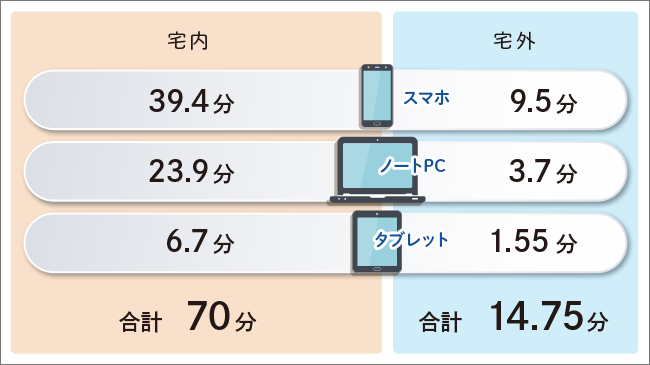
These results also suggest that "how television and smartphones—two screens—are used differently within the home" is actually a key issue that should be explored in depth through research.
With this perspective shared, let's begin structuring our discussion by first clarifying what problems we identified and what we sought to uncover.
Video Ethnography and Eye Tracking Reveal Subjects' Unconscious Behavior
The research methods we challenged ourselves with this time were "video ethnography" and "eye tracking." Considering cost and effort, both are methods we don't typically use often, but as explained in detail below, their benefits are particularly noteworthy.
Furthermore, we conducted interviews with the subjects of both studies while showing them the research footage, delving deeply into both their actions and their psychology to understand the mindset driving their behavior.
Additionally, we utilized Video Research Ltd.'s "VR CUBIC" as a preliminary screening tool. VR CUBIC is a single-source data solution that mechanically measures TV × Internet exposure to capture total audience reach. In this sense, the overall design combines qualitative research with log data.
●Video Ethnography Research
Ethnography is a qualitative research method that reveals the actual living conditions of a community based on fieldwork. It aims to achieve rich descriptions by immersing oneself in daily life, observing, and sharing experiences, and then analyzing these to depict the structure and processes of phenomena as a story.
The advantage of this research lies in uncovering unconscious insights that exist before verbalization, insights that consumers themselves are not aware of.
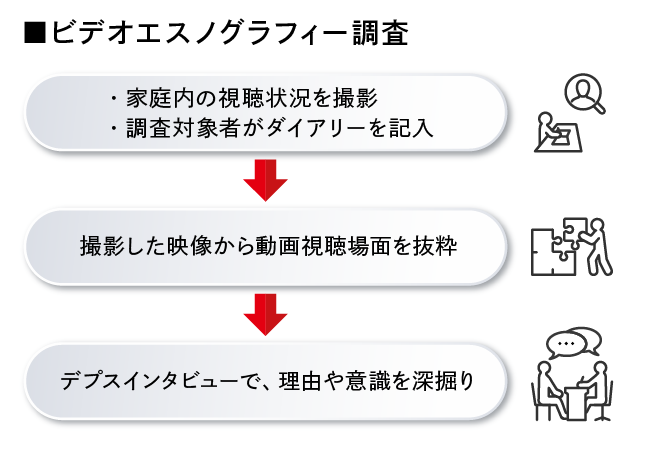
This time, we conducted the research by filming inside homes. With the subjects' permission, we installed fixed-point cameras in their homes to observe how they interacted with television and smartphone screens. This method allows us to observe "unconscious behaviors" that cannot be revealed through questionnaire surveys or behavioral log data.
● Eye Tracking Research
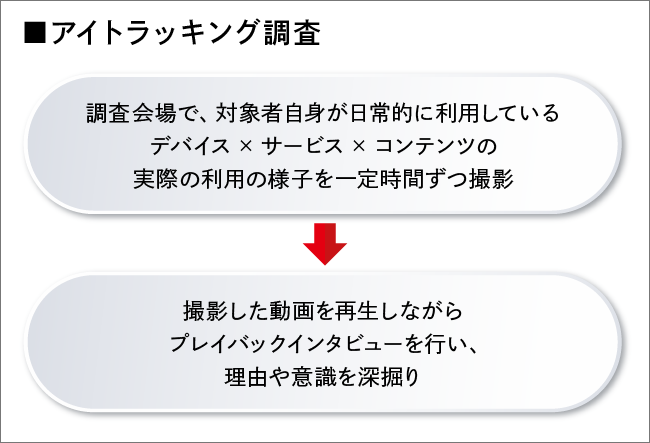
Eye tracking involves having participants wear glasses-type devices called eye trackers to monitor their gaze movements while using smartphones. This allows us to see how video content is consumed, revealing details that surveys alone cannot fully uncover.
Similar to video ethnography research, this method also focuses on revealing information behaviors that audiences are unaware of (or find difficult to consciously recognize).
The Value of TV and Smartphone Screens: Expanding and Digging
We'll save the detailed results of the actual video ethnography for next time. For now, let's grasp the broad outline of the "comparison of screen value between TV and smartphones" that emerged from the research findings.
If we were to highlight one key concept, television possesses the efficacy of "expanding," while smartphones possess the efficacy of "delving." We can begin by organizing the findings in this way.
● Television's "Expanding" Efficacy
The "expanding" aspect of TV can be summarized from the following participant comments:
- Can be watched relaxed in any preferred posture on a large screen
- Easy to watch while doing other things (can grasp content without constant focus)
- Easy to watch together with family or friends. Provides conversation topics for the gathering
- Large screen, high picture quality, and good sound create a sense of presence and immersion (high satisfaction with movies, etc.)
- The distance and screen size reduce eye strain
- Serves as background music to create a relaxed atmosphere
- Visuals brighten the space
A disadvantage is that when with family or others, it can be difficult to choose programs based solely on your own preferences. However, many people overcome this by utilizing the timeshift function.
● The "Digging" Effectiveness of Smartphones
Smartphones' "digging" capability is recognized as a highly convenient device for individual viewing and deep exploration of interests, offering the ability to watch anytime, anywhere and access desired content.
- You can watch anytime, anywhere, even while on the move
- Easy to operate
- Small screen size and close proximity to the face allow for intense focus, enabling clear viewing of even subtle movements (e.g., in combat sports)
- Brings viewers closer to those watching together, fostering intimacy
On the other hand, disadvantages include a fixed viewing posture, eye strain, and the need to constantly monitor factors like battery life and data usage.
Television and smartphones complement each other, forming a rich home information environment where users enjoy two distinct values: "expanding" and "delving" (this perspective will be further developed in future installments of this series).
The "expanding" aspect of TV refers not only to broadening one's own interests but also to its role as a mediator between people, providing topics for conversation. The survey repeatedly observed how TV serves as a common topic of conversation in households where multiple people live together.
However, a point that stood out during interviews was the opinion that, compared to the past, there seem to be fewer programs that the whole family can enjoy together or get absorbed in.
Some participants also suggested that the dominance of television content is wavering, partly due to the proliferation of online video services. Furthermore, voices emerged indicating that with television devices, people prioritize watching recorded content over live broadcasts. We will revisit this mindset of controlling viewing time to enhance performance in the latter part of this series.
Eye-tracking reveals smartphones' "digging" efficacy
Smartphone "digging" enables deep exploration of personal interests, but it also signifies that users' attention disperses in multiple directions.
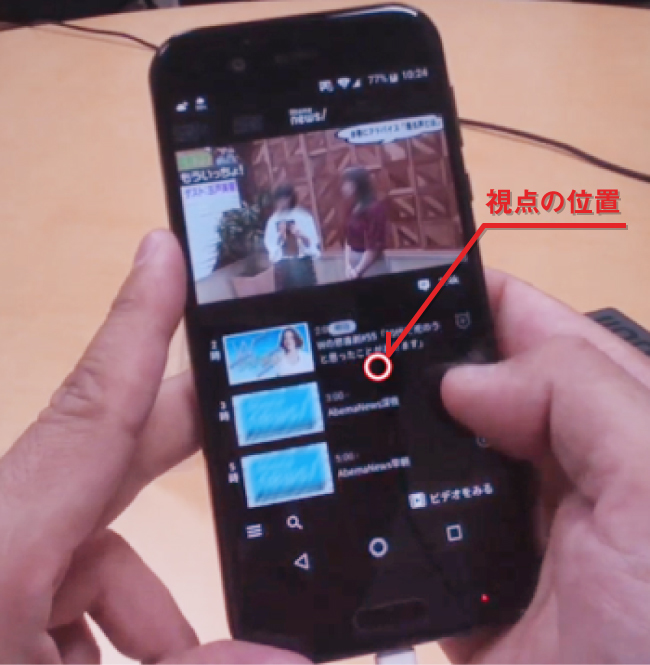
For instance, the scenario below shows that even when watching videos on smartphones, the fundamental premise is vertical viewing for channel-surfing. Rather than watching videos full-screen, users keep one eye on the video while simultaneously directing attention to other related programs. It suggests that options for channel-surfing are constantly present within the screen.
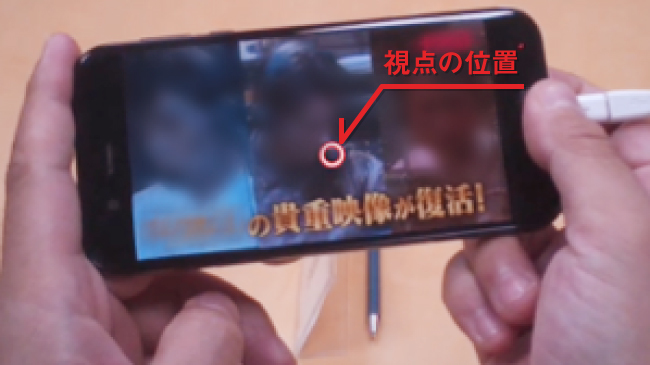
Conversely, horizontal viewing often involves selective or focused viewing, with less channel-hopping or switching to other programs. Users frequently showed interest in ads, drawn by commercials. The user in the image below, being a music enthusiast, encountered an ad for a paid streaming channel. Seeing their favorite artist featured, they stated they considered subscribing to that service.
The advent of smartphones as "digging" devices has shifted the value domain traditionally held by TV as a "spreading" device, leading consumers to value both equally. The normalization of "digging" also significantly impacts how we allocate our limited attention resources.
This time, we were able to grasp consumers' information behaviors through video. What we gained a more tangible understanding of is this: "When considering the contrast between TV and smartphones, we must also factor in the environment surrounding the screen—whether it's watched with family or alone, which room it's in, and so on."
[Survey Overview]
●Research Method:
・Video Ethnography Study
Video cameras were installed in participants' homes to record two days of television viewing. After capturing the actual behavior, depth interviews were conducted later based on the footage to delve deeper into the "reasons" and "awareness" behind the actions.
・Eye-tracking study
Participants wore specialized equipment at the research facility to measure their eye movements while viewing smartphones. Following this, interviews were conducted while showing the measurement data to delve deeper into the "reasons" and "awareness" behind the results.
●Study Name: Dentsu Inc. Video Research Ltd. Joint "Back to TV" Study
●Target Area: Greater Tokyo Area (Tokyo and three surrounding prefectures)
● Eligibility Criteria:
・Individuals who consistently watch videos on both TV screens and smartphones
・Excludes those who never watch TV broadcasts
・Users of any major video service (YouTube, Amazon Prime Video, AbemaTV, etc.)
・Frequent social media users (Instagram, Facebook, Twitter)
・Ages 20s to 40s (excluding media and market research professionals)
●Sample size: 5 people
● Survey period: September–November 2018
●Research organization: Video Research Ltd.
Was this article helpful?
Share this article


Newsletter registration is here
We select and publish important news every day
For inquiries about this article
Author