Note: This website was automatically translated, so some terms or nuances may not be completely accurate.
 The Reiwa "New" Era! Where is the Media Society Headed? [3/6]
Women use smartphones for communication, while men use them for videos.
This series highlights key content from the opening feature of the "Information Media White Paper 2020 " (published by Diamond Inc.), edited by Dentsu Inc. Media Innovation Lab. Previously, we examined how, depending on the generation, SNS can rival mass media in influence ( Part 1 ) and how the internet is primarily accessed via smartphones at home ( Part 2 ), supported by relevant data.
This installment delves into how apps are used on smartphones, which play a crucial role in internet usage.
Smartphones are often used during very brief moments of downtime, making it rare to observe their actual usage patterns. Analysis(*) by Dentsu Inc. Media Innovation Lab revealed significant differences in daily app usage trends not only by age but also by gender.
※Analysis based on smartphone app usage logs from Intage Inc.'s i-SSP Mobile Panel (January 2019), standardized across iOS and Android apps and categories
Men in their teens and twenties show high affinity for "video sharing" apps
Figure 1 shows the minute-by-minute app launch rate progression throughout the day, starting at 5:00 AM, for male teens (ages 15-19). The most frequently launched category, shown in gray, is "Browser/Portal." This category is widely used across all age groups, suggesting it is used not only for web browsing but also for frequent search activities.
[Figure 1]
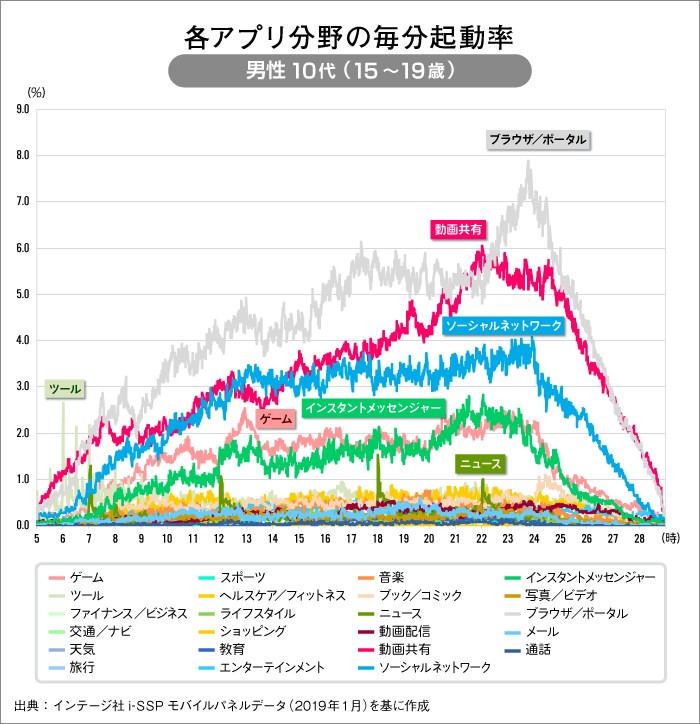
The most distinctive feature among male teens is the high usage rate of "Video Sharing" apps, represented by the red line, exemplified by YouTube. Excluding "Browser/Portal," "Video Sharing" usage is consistently the highest throughout the day, reaching a significant peak during the late-night hours after 10 PM.
For males in their 20s, usage of "Social Networks" (Twitter, Instagram, Facebook, etc.) exceeds "Video Sharing" during the daytime. However, after 9:00 PM, this relationship reverses, with "Video Sharing" usage rapidly peaking around midnight. This highlights the exceptionally high usage of video sharing apps among males in their teens and 20s.
Social Network Usage Dominates Among Women Aged 10-29
What about female teens (ages 15-19)? Excluding "Browser/Portal," the blue line representing "Social Networks" shows extremely active usage throughout the day, far outpacing other app categories (Figure 2).
[Figure 2]
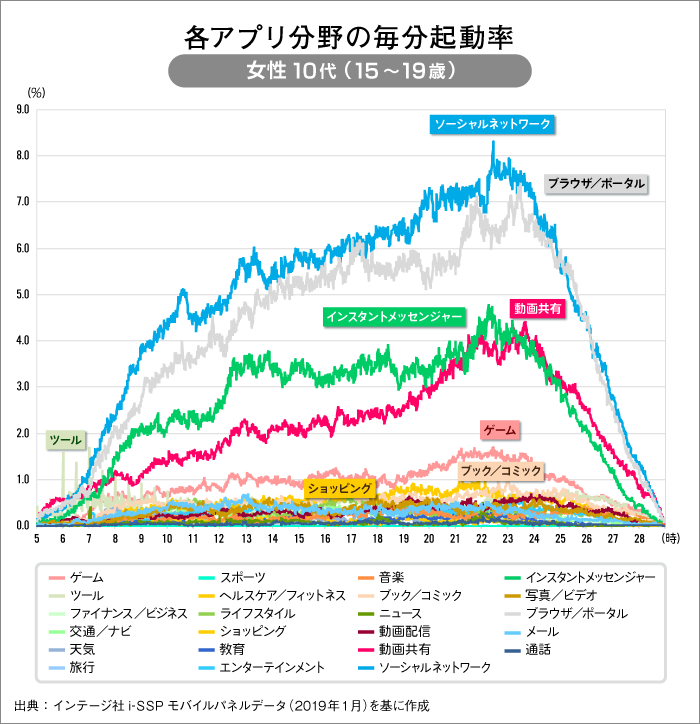
The green "Instant Messengers," represented by LINE, follow "Social Networks." While "Video Sharing" usage increases into the late night hours, it rarely exceeds the usage level of "Instant Messengers," except during the hours after midnight.
Among women in their 20s, the order of app usage—Social Networking, Instant Messaging, Video Sharing—remains unchanged. Even within the same young demographic, women actively use communication-focused apps throughout the day, showing a different trend compared to men, who place a higher emphasis on Video Sharing.
App usage among men in their 60s is limited
Young people in their teens and twenties, often called digital natives, are a generation that grew up alongside smartphones. So, how do middle-aged and older adults, who transitioned to smartphones via PCs and feature phones (traditional mobile phones), use their smartphones? Here, we look at the situation for those in their 60s.
Figure 3 shows app usage among men in their 60s. The only category showing consistently high usage throughout the day is "Browser/Portal"; there is no indication of active use of other apps.
[Figure 3]
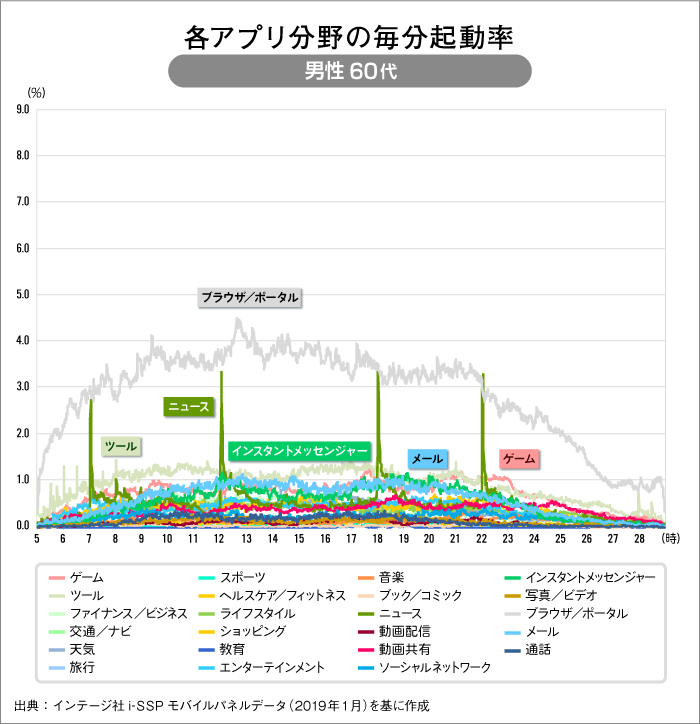
The dark green "News" apps stand out. This likely indicates they launch news apps at specific times like morning or noon, triggered by scheduled push notifications. Also, the light blue "Email" apps are used alongside "Instant Messengers." This generation's strong retention of email culture may be a defining characteristic.
Are women in their 60s hidden heavy users of "Games"?
On the other hand, women in their 60s appear to use smartphone apps more actively (Figure 4). Looking beyond "Browser/Portal," they frequently use "Instant Messenger." Their use of "Email" also suggests they engage in communication activities via smartphone. However, the most frequently used category is "Games," shown in pink.
[Figure 4]
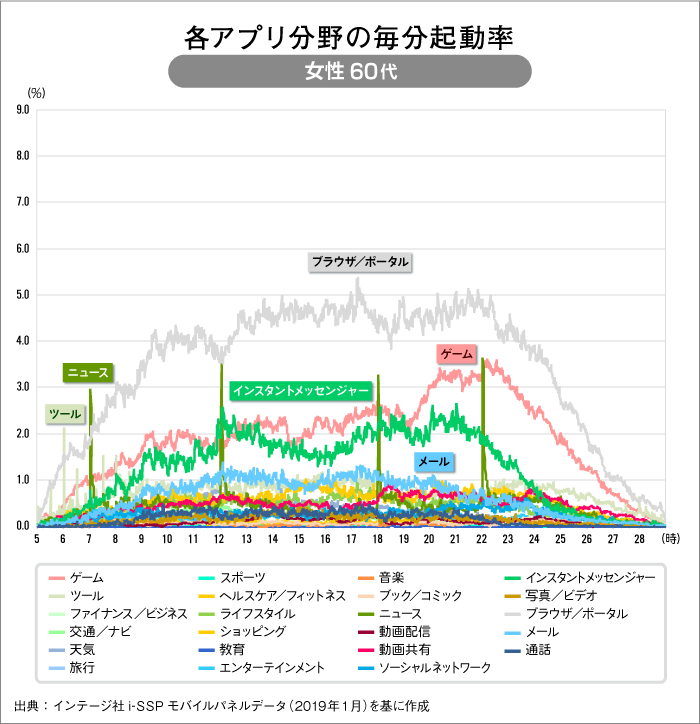
While "Games" is a popular category across all age groups, women aged 40 and above show a notably distinct usage pattern compared to other apps. Men in their 40s and 50s also frequently use "Games," but their usage tends to be concentrated in specific time slots: morning, afternoon, and evening. In contrast, the usage rate among middle-aged and older women remains high throughout the day, showing a gradual increase toward late night.
Women in this age group, likely engaging with casual games during spare moments at home or relaxing before bed, may be the hidden heavy users of game apps.
Various data reveal the remarkably diverse ways people engage with media. Against a backdrop of technological evolution, numerous media services have emerged. People flexibly interact with these services according to their own experiences, values, and daily rhythms, accepting those that resonate with their sensibilities and fit their lifestyles.
While the era has shifted from Heisei to Reiwa, developing services that closely align with the diverse needs and media perspectives of these users will be more crucial than ever for building a rich media society.
Was this article helpful?
Share this article


Newsletter registration is here
We select and publish important news every day
For inquiries about this article
Back Numbers
Author

Mariko Morishita
Dentsu Inc.
Marketing Administration Center, Media Innovation Research Department (Dentsu Inc. Media Innovation Lab)
Insight MemoThe Reiwa "New" Era! Where is the Media Society Headed?How has media consumption changed in response to the COVID-19 pandemic?New Approaches Discovered Through Audience ResearchInformation Media White Paper 2022: Unraveling Media Consumption and Dissemination in the "With COVID-19" EraInformation Media White Paper 2023: What You Need to Know Now—The Past, Present, and Future of Media and SocietyInformation Media White Paper 2024: The Rapidly Changing Media Environment and Consumers100 years since its birth. Radio, today...Information Media White Paper 2025: New Horizons in Communication Shaping the FutureA Space for Collective ThoughtInformation Media White Paper Special Report 2026: “The Current State of Evolving Information Trends”