Note: This website was automatically translated, so some terms or nuances may not be completely accurate.
 Information Media White Paper 2024: The Rapidly Changing Media Environment and Consumers [3/3]
The Role and Nature of Media as Seen in the Foreword of the "Information Media White Paper"
The "Information Media White Paper 2024" (edited by Dentsu Media Innovation Lab / DENTSU SOKEN INC., published by Diamond Inc.) was released on March 1st. This year marks the 31st edition of this data book, which reveals the full landscape of the information media industry.
The special feature "The Rapidly Changing Media Environment and Consumers" explains trends in the information media market and people's behaviors across the following four articles:
- Media Usage Behavior: Swing Back and Stabilization Before and After the Pandemic – Polarization Advances
- Media Usage Among Infants, Toddlers, and Elementary School Children
- The Impact of Generative AI on the Creative Industries
- The Current State and Future Potential of Audio Media Revitalized by Digital Services
This time, Ritsuya Oku, Head of Dentsu Inc. Media Innovation Lab and Honorary Fellow at DENTSU SOKEN INC. (his 14th overall), looks back on past editorials.
▼Forewords that continuously raised challenges regarding media's role and existence over 14 years
▼New perspectives for maintaining broadcasting infrastructure revealed by the Noto Peninsula Earthquake
▼Future broadcasting challenges will be concentrated in the "share of time spent with in-home video media"
Editorial: 14 Years of Raising Questions About the Role and Nature of Media
The first year I was responsible was the 2011 edition, coinciding with the year domestic television broadcasting completed its digital transition with the analog shutdown. (The analog shutdown was originally scheduled for July 24, 2011, but following the Great East Japan Earthquake in March, the shutdown was postponed by one year in the three Tohoku prefectures.)
Listing the titles of the editorials chronologically from that year up to the latest 2024 edition yields the arrangement shown below.
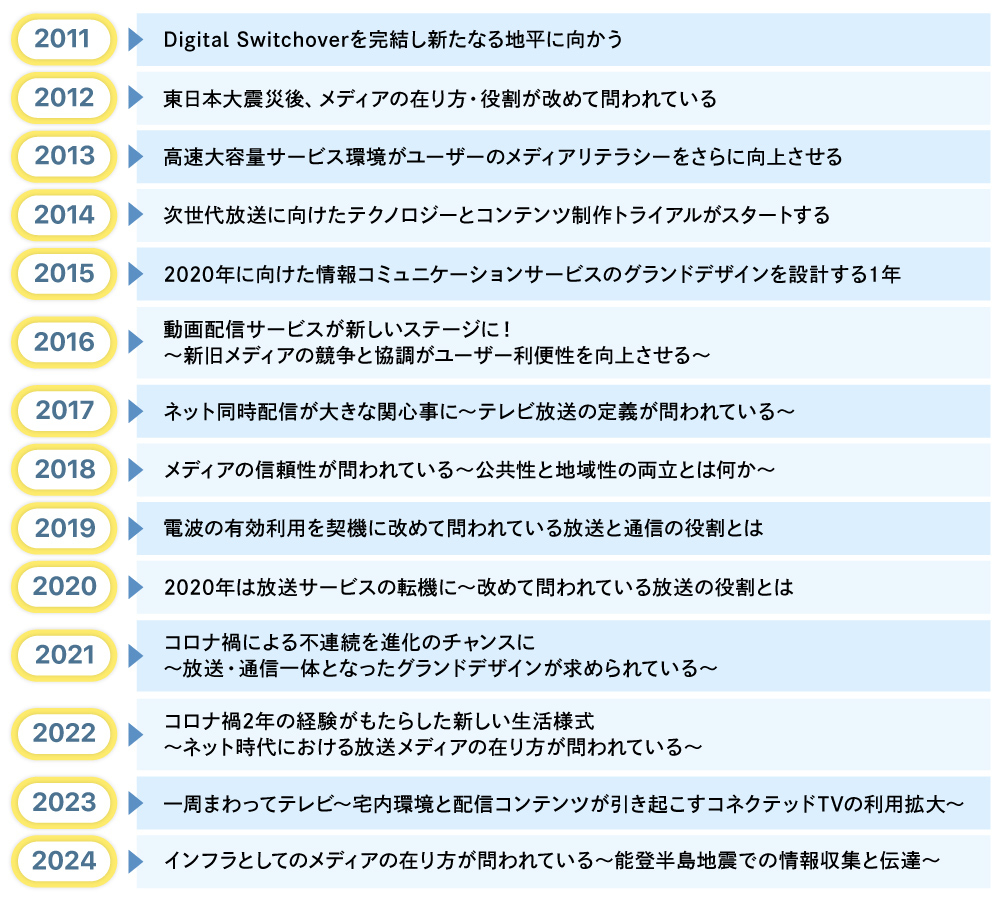
Looking at them side by side like this, we can reflect on how these 14 years have consistently raised questions about the role and nature of media. The editorial is submitted in the second week of January each year. In that sense, it truly reflects the sense of the times I feel at the beginning of that year.
The latest 2024 edition's opening statement is titled: "2024: Questioning the Role of Media as Infrastructure – Information Gathering and Dissemination During the Noto Peninsula Earthquake."
This title was chosen after reviewing the coverage of the earthquake that struck the Noto Peninsula on New Year's Day.
The opening lines state: "2024 began with events that shook Japan's infrastructure, including the Noto Peninsula Earthquake and the aircraft accident at Haneda Airport. The Noto Peninsula Earthquake caused houses to collapse due to the earthquake and tsunami, severing vital roads and halting rail and air transport.In addition to water and power outages, landlines and mobile phones were inaccessible. Terrestrial broadcasts ceased as emergency fuel supplies to small relay stations ran out, making television viewing impossible. Life and information infrastructure collapsed. Numerous residents were forced into evacuation, and many areas became isolated, making damage assessment and recovery extremely difficult."
The Noto Peninsula is a peninsula surrounded by sea. The earthquake struck there. With the road network, which plays a major role as a life-sustaining infrastructure, severed, it became difficult to obtain real-time information about what was happening on the ground. It took time to confirm the damage situation in isolated communities, which is the initial step in disaster response.The extreme scarcity of updates on the local disaster situation immediately after the quake served as a stark reminder that news reporting functions only when based on the premise of two-way information flow—both up and down.
The flow of information—where local residents and municipalities verify details, or neighboring municipalities and the Prime Minister's Office confirm them—remained severely hampered by the disruption of broadcasting and communication networks.
New Perspectives on Maintaining Broadcasting Infrastructure Revealed by the Noto Peninsula Earthquake
Looking back, parts of Suzu City and Noto Town in Ishikawa Prefecture were designated as model areas during the full transition to terrestrial digital broadcasting. Analog broadcasting in these areas ceased at noon on July 24, 2010, one year ahead of the nationwide transition.I visited the area at the time of the switch-off and witnessed that moment. Approximately 8,800 households in the region were affected by the early switch-off, losing access to terrestrial analog broadcasts from NHK and four commercial broadcasters.
The region was selected for early implementation due to factors such as its location at the tip of the Noto Peninsula, surrounded on three sides by the Sea of Japan, making radio wave interference with other regions less likely. Additionally, cable television was widely adopted, providing a robust backup system. The geographical characteristics of the Noto Peninsula were key factors in selecting it as a model district for terrestrial digital broadcasting, revealing a similar background to the challenges faced by broadcasting infrastructure during the earthquake that occurred this past New Year.
Following the earthquake, NHK implemented temporary measures to convey detailed information about the disaster area both locally and nationwide. This included using Channel 103, formerly occupied by BS Premium (which ended service at the end of 2023), to broadcast the Kanazawa Broadcasting Station's terrestrial general channel.Subsequently, the Ministry of Internal Affairs and Communications approved NHK's application on March 29, 2024, authorizing satellite broadcasting services for "temporary and provisional broadcasting purposes," allowing operations to continue beyond April.
This measure became an opportunity to introduce a new point of discussion—maintaining broadcasting infrastructure during both normal and emergency times—within the Ministry of Internal Affairs and Communications' ongoing deliberations at the "Study Group on the Future of Broadcasting Systems in the Digital Age" (hereafter: Broadcasting System Review).In any situation, we cannot expect services not used routinely during normal times to function effectively during emergencies. Therefore, it is crucial to design normal-time services with the maintenance of emergency infrastructure in mind. This perspective is now receiving renewed focus, leading to broad discussions on broadcasting infrastructure challenges.
The future challenge for broadcasting boils down to the "share of time spent with in-home video media."
The Broadcasting System Review Committee commenced in November 2021, succeeding the "Study Group on Various Issues Concerning Broadcasting" (2015–present, hereafter "Study Group"). My core concern as a committee member has been centered on the "share of contact time with in-home video media," introduced in the lead feature of the "Information Media White Paper 2024."
Figure 2 presents the results of compiling Video Research Ltd.'s MCR/ex data (Tokyo 50km radius, June 2023) to understand home-based video media usage trends. It shows the average weekly daily exposure time to video media via broadcast and via the internet.
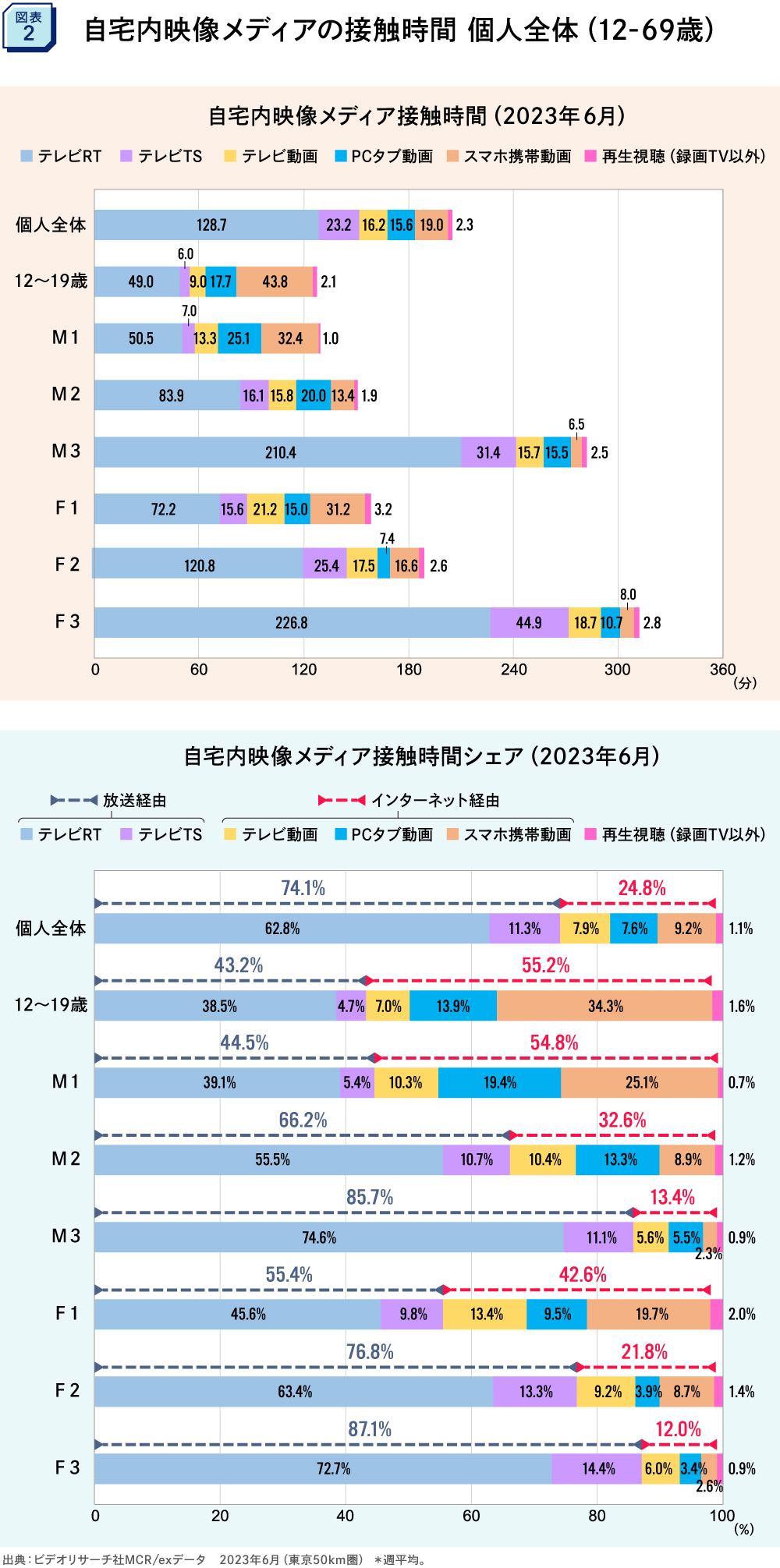 *Share rates (%) are rounded to the second decimal place. Therefore, the sum of the "Broadcast" and "Internet" figures may not equal the total of their individual values.
Broadcast-based media includes "TV RT (real-time viewing of TV programs)" and "TV TS (viewing recorded TV programs)". Internet-based media includes "TV Video (viewing online videos on a TV screen)", "PC/Tablet Video", and "Smartphone/Mobile Video".Additionally, though accounting for a smaller share of time, "Playback Viewing (Other Than Recorded TV)" covers package media playback like DVDs. Figure 2 shows the contact time and time share for each video medium by demographic.
Noteworthy is the share of video media contact time via broadcast versus internet among younger demographics. For males and females aged 12-19, broadcast accounts for 43.2% and internet for 55.2%.Similarly, among M1 (men aged 20-34), broadcast accounts for 44.5% and online for 54.8% of video media contact time share. Here, broadcast falls below 50%, with online surpassing broadcast. Among F1 (women aged 20-34), broadcast accounts for 55.4% and online for 42.6%. While broadcast exceeds online here, the difference between the two is not significantly large.
Turning to older demographics, M3 (men aged 50–69) shows 85.7% via broadcast and 13.4% via internet, while F3 (women aged 50–69) shows 87.1% via broadcast and 12.0% via internet. This indicates broadcast accounts for nearly 90% of the share, a very large proportion.This significant generational gap is critically important as a premise for discussions within the Broadcasting Standards Council.
Over the nearly four years of the COVID-19 pandemic, audience media usage behavior has changed dynamically. The magnitude of this change is greater than pre-pandemic trends and stems from shifts in viewers' lifestyles.
The "Information Media White Paper 2024" Special Feature PART 1, "Before and After COVID-19: Swings and Settlements – Polarizing Media Usage Behavior," details these shifts and the discussions within the Ministry of Internal Affairs and Communications' advisory bodies. Please refer to it.
■ Details of the "Information Media White Paper 2024" can be found here.

Was this article helpful?
Share this article


Newsletter registration is here
We select and publish important news every day
For inquiries about this article
Back Numbers
Author

Ritsuya Oku
Representative of Media Vision Lab
Honorary Fellow, DENTSU SOKEN INC. / Director, Video Research Ltd. Media Design Institute
Joined Dentsu Inc. in 1982. Served in Media Services / Radio,TV Division, Media Marketing Division, and later held positions as Fellow at DENTSU SOKEN INC. and Head of Dentsu Media Innovation Lab. Left Dentsu Inc. at the end of June 2024. Established Media Vision Lab, a personal consulting practice. Primarily provides consulting services to media-related companies in the information and communications sector, focusing on three perspectives: business, audience, and technology.
Publications include: "The Birth of Neo-Digital Natives: The Internet Generation Evolving Uniquely in Japan" (co-authored, Diamond Inc.), "An Explanatory Guide to 'The TV Theory That Has Come Full Circle' and the Outlook for Broadcasting Services" (co-authored, New Media), "Confirming the Acceptability of Simultaneous Online Streaming of Broadcasts" ("Nextcom" Vol. 2017 No. 32, KDDI Research Institute), "New Media Textbook 2020" (co-authored, Sendenkaigi), "70-Year History of Commercial Broadcasting" (co-authored, National Association of Commercial Broadcasters in Japan), "Broad and Universal Online Distribution / NHK and Commercial Broadcasters: From Competition to Cooperation" ("Journalism" December 2022 issue, Asahi Shimbun), and "Information Media White Paper 2024" (co-authored, Diamond Inc.). Member of the Ministry of Internal Affairs and Communications' "Study Group on the Future of Broadcasting Systems in the Digital Age." Member of the Publishing and Editorial Committee, NPO/Broadcasting Critics Conference.SeriesThe Future of Media"2014 Japan Advertising Expenditures" Special InterviewSmartphones and the JapaneseShiodome Media Researcher CommentarySpecial Discussion: "Japan's Advertising Expenditures"The Near Future of Advertising from the Device's PerspectiveSmartphones: A Decade of Creative DestructionThe "Time Performance Era": How Should We Design Viewing Environments for Consumers?Information Media White Paper 2024: The Rapidly Changing Media Environment and Consumers
dentsu Media Innovation Lab
Dentsu Inc.
Launched in October 2017, leveraging Dentsu Inc.'s longstanding media and audience research expertise. Conducts research and disseminates insights to capture shifts in people's diverse information behaviors and understand the broader media landscape. Provides proposals and consulting on the communication approaches companies need within this context.
SeriesInsight MemoSpecial Discussion: "Japan's Advertising Expenditures"Explore the Amazing World of YouTube Creators with UUUMInformation Media White Paper 2024: The Rapidly Changing Media Environment and Consumers100 years since its birth. Radio, today...College Students and the Future of Media, Communication, and Advertising in Ten YearsInformation Media White Paper 2025: New Horizons in Communication Shaping the FutureInformation Media White Paper Special Report 2026: “The Current State of Evolving Information Trends”Also read
▼Forewords that continuously raised challenges regarding media's role and existence over 14 years
▼New perspectives for maintaining broadcasting infrastructure revealed by the Noto Peninsula Earthquake
▼Future broadcasting challenges will be concentrated in the "share of time spent with in-home video media"
Editorial: 14 Years of Raising Questions About the Role and Nature of Media
The first year I was responsible was the 2011 edition, coinciding with the year domestic television broadcasting completed its digital transition with the analog shutdown. (The analog shutdown was originally scheduled for July 24, 2011, but following the Great East Japan Earthquake in March, the shutdown was postponed by one year in the three Tohoku prefectures.)
Listing the titles of the editorials chronologically from that year up to the latest 2024 edition yields the arrangement shown below.
Looking at them side by side like this, we can reflect on how these 14 years have consistently raised questions about the role and nature of media. The editorial is submitted in the second week of January each year. In that sense, it truly reflects the sense of the times I feel at the beginning of that year.
The latest 2024 edition's opening statement is titled: "2024: Questioning the Role of Media as Infrastructure – Information Gathering and Dissemination During the Noto Peninsula Earthquake."
This title was chosen after reviewing the coverage of the earthquake that struck the Noto Peninsula on New Year's Day.
The opening lines state: "2024 began with events that shook Japan's infrastructure, including the Noto Peninsula Earthquake and the aircraft accident at Haneda Airport. The Noto Peninsula Earthquake caused houses to collapse due to the earthquake and tsunami, severing vital roads and halting rail and air transport.In addition to water and power outages, landlines and mobile phones were inaccessible. Terrestrial broadcasts ceased as emergency fuel supplies to small relay stations ran out, making television viewing impossible. Life and information infrastructure collapsed. Numerous residents were forced into evacuation, and many areas became isolated, making damage assessment and recovery extremely difficult."
The Noto Peninsula is a peninsula surrounded by sea. The earthquake struck there. With the road network, which plays a major role as a life-sustaining infrastructure, severed, it became difficult to obtain real-time information about what was happening on the ground. It took time to confirm the damage situation in isolated communities, which is the initial step in disaster response.The extreme scarcity of updates on the local disaster situation immediately after the quake served as a stark reminder that news reporting functions only when based on the premise of two-way information flow—both up and down.
The flow of information—where local residents and municipalities verify details, or neighboring municipalities and the Prime Minister's Office confirm them—remained severely hampered by the disruption of broadcasting and communication networks.
New Perspectives on Maintaining Broadcasting Infrastructure Revealed by the Noto Peninsula Earthquake
Looking back, parts of Suzu City and Noto Town in Ishikawa Prefecture were designated as model areas during the full transition to terrestrial digital broadcasting. Analog broadcasting in these areas ceased at noon on July 24, 2010, one year ahead of the nationwide transition.I visited the area at the time of the switch-off and witnessed that moment. Approximately 8,800 households in the region were affected by the early switch-off, losing access to terrestrial analog broadcasts from NHK and four commercial broadcasters.
The region was selected for early implementation due to factors such as its location at the tip of the Noto Peninsula, surrounded on three sides by the Sea of Japan, making radio wave interference with other regions less likely. Additionally, cable television was widely adopted, providing a robust backup system. The geographical characteristics of the Noto Peninsula were key factors in selecting it as a model district for terrestrial digital broadcasting, revealing a similar background to the challenges faced by broadcasting infrastructure during the earthquake that occurred this past New Year.
Following the earthquake, NHK implemented temporary measures to convey detailed information about the disaster area both locally and nationwide. This included using Channel 103, formerly occupied by BS Premium (which ended service at the end of 2023), to broadcast the Kanazawa Broadcasting Station's terrestrial general channel.Subsequently, the Ministry of Internal Affairs and Communications approved NHK's application on March 29, 2024, authorizing satellite broadcasting services for "temporary and provisional broadcasting purposes," allowing operations to continue beyond April.
This measure became an opportunity to introduce a new point of discussion—maintaining broadcasting infrastructure during both normal and emergency times—within the Ministry of Internal Affairs and Communications' ongoing deliberations at the "Study Group on the Future of Broadcasting Systems in the Digital Age" (hereafter: Broadcasting System Review).In any situation, we cannot expect services not used routinely during normal times to function effectively during emergencies. Therefore, it is crucial to design normal-time services with the maintenance of emergency infrastructure in mind. This perspective is now receiving renewed focus, leading to broad discussions on broadcasting infrastructure challenges.
The future challenge for broadcasting boils down to the "share of time spent with in-home video media."
The Broadcasting System Review Committee commenced in November 2021, succeeding the "Study Group on Various Issues Concerning Broadcasting" (2015–present, hereafter "Study Group"). My core concern as a committee member has been centered on the "share of contact time with in-home video media," introduced in the lead feature of the "Information Media White Paper 2024."
Figure 2 presents the results of compiling Video Research Ltd.'s MCR/ex data (Tokyo 50km radius, June 2023) to understand home-based video media usage trends. It shows the average weekly daily exposure time to video media via broadcast and via the internet.
Broadcast-based media includes "TV RT (real-time viewing of TV programs)" and "TV TS (viewing recorded TV programs)". Internet-based media includes "TV Video (viewing online videos on a TV screen)", "PC/Tablet Video", and "Smartphone/Mobile Video".Additionally, though accounting for a smaller share of time, "Playback Viewing (Other Than Recorded TV)" covers package media playback like DVDs. Figure 2 shows the contact time and time share for each video medium by demographic.
Noteworthy is the share of video media contact time via broadcast versus internet among younger demographics. For males and females aged 12-19, broadcast accounts for 43.2% and internet for 55.2%.Similarly, among M1 (men aged 20-34), broadcast accounts for 44.5% and online for 54.8% of video media contact time share. Here, broadcast falls below 50%, with online surpassing broadcast. Among F1 (women aged 20-34), broadcast accounts for 55.4% and online for 42.6%. While broadcast exceeds online here, the difference between the two is not significantly large.
Turning to older demographics, M3 (men aged 50–69) shows 85.7% via broadcast and 13.4% via internet, while F3 (women aged 50–69) shows 87.1% via broadcast and 12.0% via internet. This indicates broadcast accounts for nearly 90% of the share, a very large proportion.This significant generational gap is critically important as a premise for discussions within the Broadcasting Standards Council.
Over the nearly four years of the COVID-19 pandemic, audience media usage behavior has changed dynamically. The magnitude of this change is greater than pre-pandemic trends and stems from shifts in viewers' lifestyles.
The "Information Media White Paper 2024" Special Feature PART 1, "Before and After COVID-19: Swings and Settlements – Polarizing Media Usage Behavior," details these shifts and the discussions within the Ministry of Internal Affairs and Communications' advisory bodies. Please refer to it.
■ Details of the "Information Media White Paper 2024" can be found here.
Was this article helpful?
Share this article
Newsletter registration is here
We select and publish important news every day
For inquiries about this article
Back Numbers
Author
Ritsuya Oku
Representative of Media Vision Lab
Honorary Fellow, DENTSU SOKEN INC. / Director, Video Research Ltd. Media Design Institute
The Future of Media"2014 Japan Advertising Expenditures" Special InterviewSmartphones and the JapaneseShiodome Media Researcher CommentarySpecial Discussion: "Japan's Advertising Expenditures"The Near Future of Advertising from the Device's PerspectiveSmartphones: A Decade of Creative DestructionThe "Time Performance Era": How Should We Design Viewing Environments for Consumers?Information Media White Paper 2024: The Rapidly Changing Media Environment and Consumers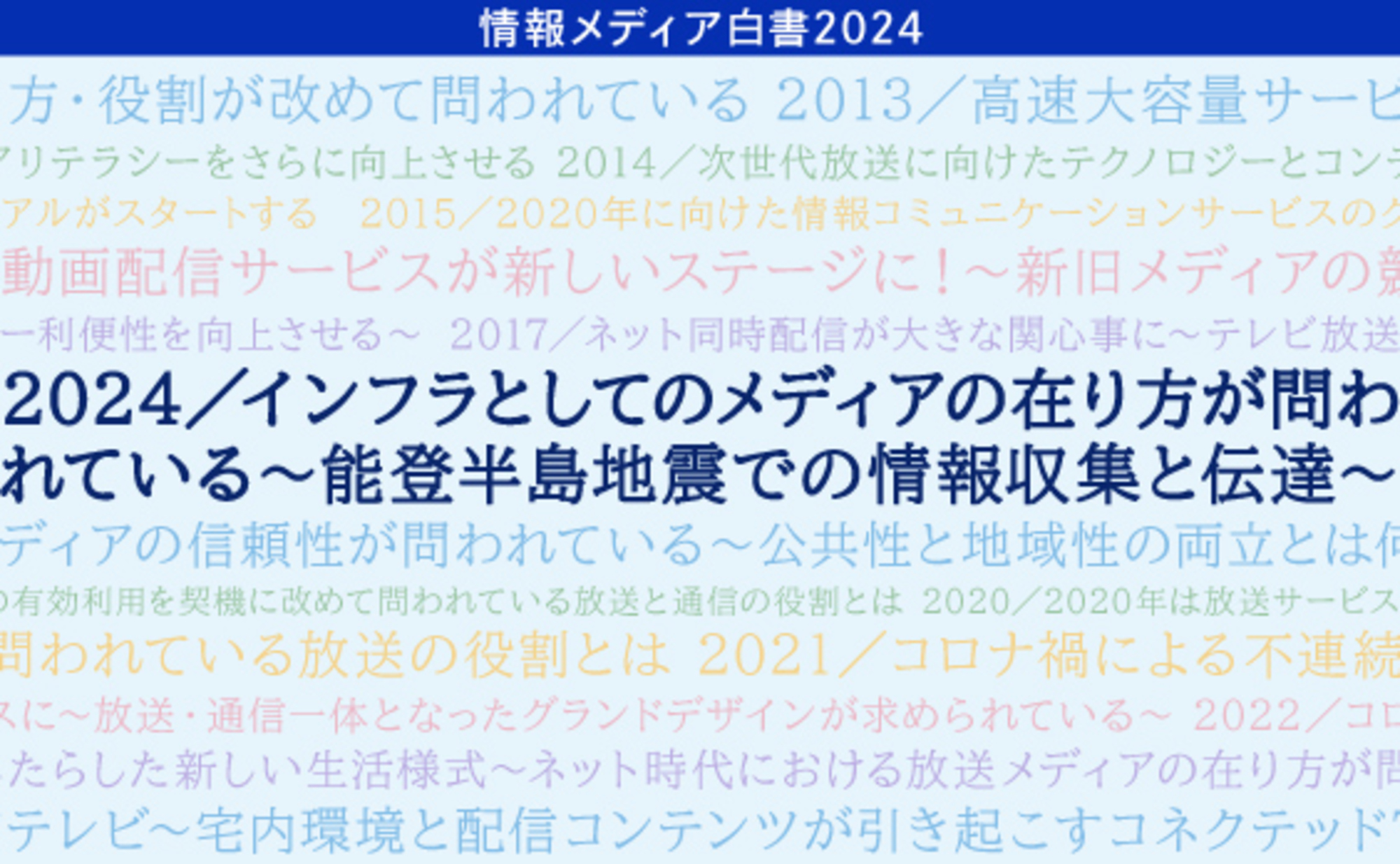
dentsu Media Innovation Lab
Dentsu Inc.
Insight MemoSpecial Discussion: "Japan's Advertising Expenditures"Explore the Amazing World of YouTube Creators with UUUMInformation Media White Paper 2024: The Rapidly Changing Media Environment and Consumers100 years since its birth. Radio, today...College Students and the Future of Media, Communication, and Advertising in Ten YearsInformation Media White Paper 2025: New Horizons in Communication Shaping the FutureInformation Media White Paper Special Report 2026: “The Current State of Evolving Information Trends”