Note: This website was automatically translated, so some terms or nuances may not be completely accurate.
 Insight Memo [56/65]
Identifying the "Ideal" Video Advertising Media Through Six Factors
Once, "video advertising" primarily meant commercials aired on broadcast media centered around terrestrial television. But times have changed, and today's consumers encounter video ads across a wide range of media platforms, each offering different content and serving different purposes.
Video sharing services like "YouTube."
Video streaming services like "GYAO!" and the commercial broadcaster official TV portal "TVer".
Social networking services like Facebook and Twitter.
Text-based online media like digital editions of newspapers and magazines, and curated sites.
And even video displays inside trains.
How do the differing characteristics of these media influence advertising effectiveness (i.e., changes in user attitudes)?
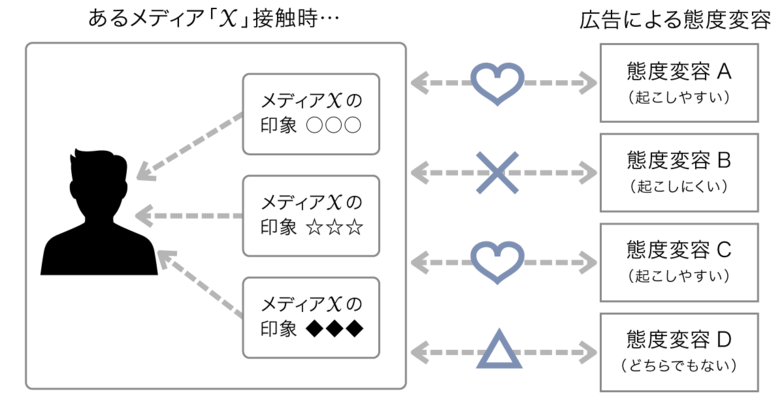
"Could the impressions consumers receive when using media, and the differences in the experiences they expect from media (usage characteristics), be influencing the attitude change effect of advertising?"
Based on this hypothesis, DENTSU SOKEN INC. conducted a web survey titled "Analysis of Usage Characteristics and Attitude Change in Video Advertising Media" targeting men and women aged 15 to 59 nationwide.
![仮説 [1]同じ動画広告でも… [2]載せるメディアの利用特性の違いによって… [3]ユーザーに起こしやすい態度変容(=広告効果)が異なるのでは?](https://cdn.dentsu-ho-dev.com/e2b1eedb-40a1-4fff-86d5-bccaca2f0058/content_insightmemo56_2_01.png)

This paper introduces some of the survey results and proposes a method for inferring the "ideal" media using six factors extracted from the survey.
■Survey: "Analysis of Usage Characteristics and Attitude Change in Video Advertising Media"
(Detailed survey conditions are listed at the end of the article)
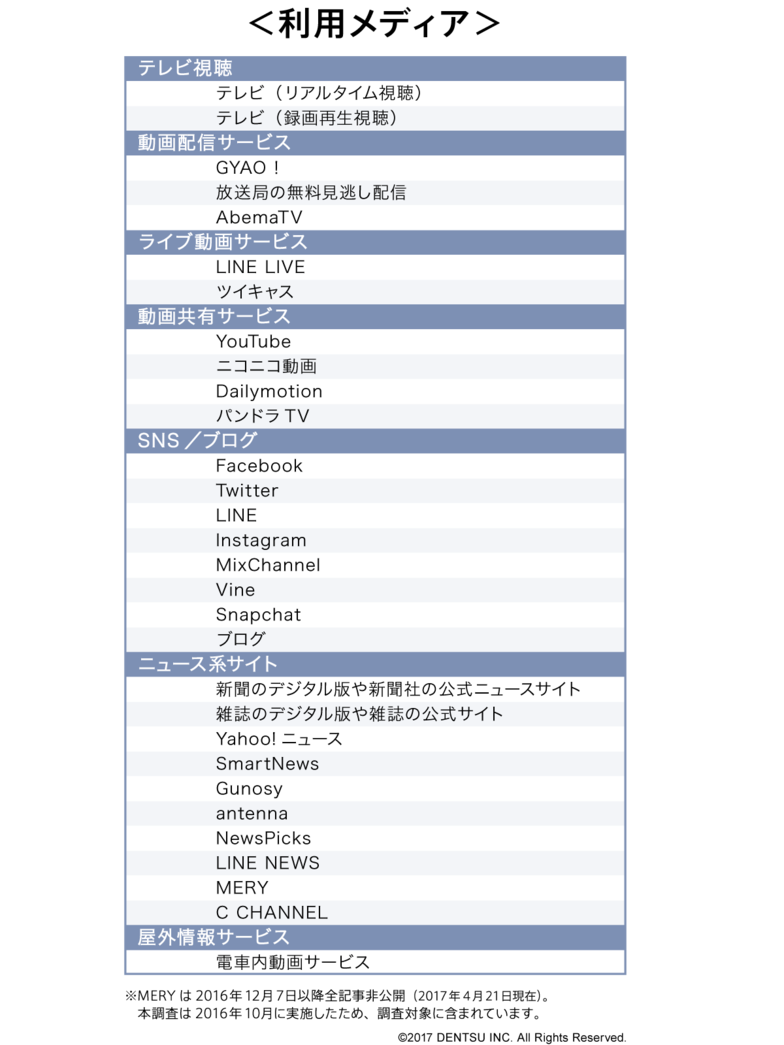
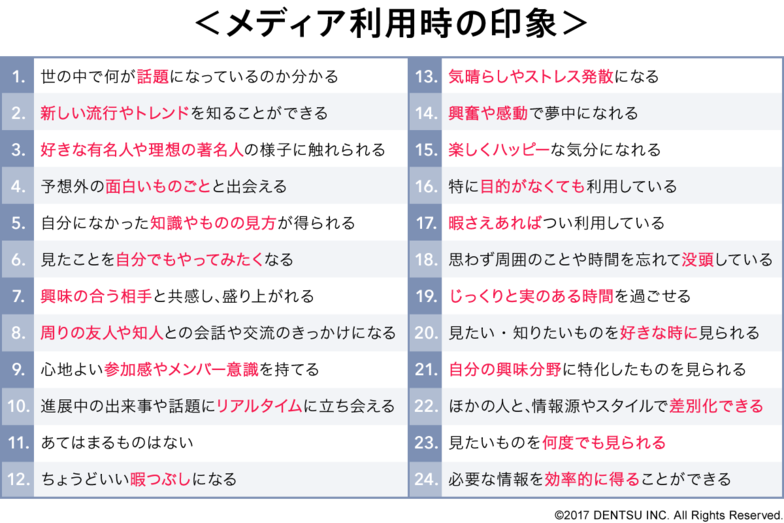
●Candidate Media: 30 types across 7 categories; 23 impression items were set. Consideration was given to reflect the current trend toward media diversification as much as possible.
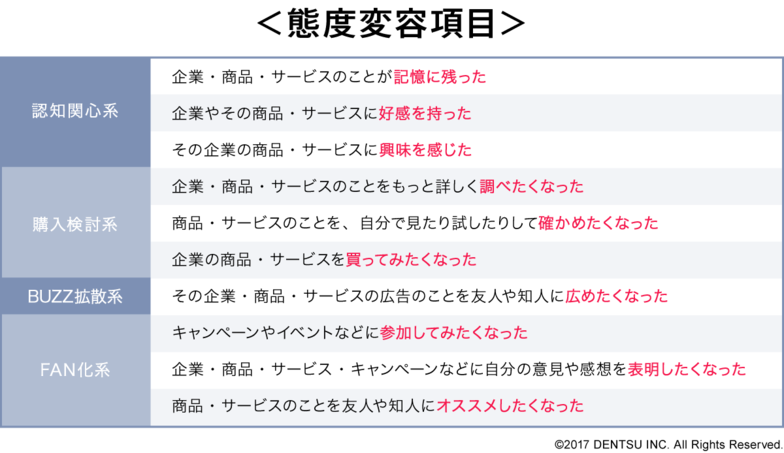
● Attitude Change Items: Attitude change was defined across 4 categories and 10 items. Reflecting recent campaign trends, we included "attitude changes not directly related to purchase," such as "BUZZ diffusion" and "FAN conversion."
●Survey Content: Respondents were asked about "media usage experience," "impressions during use," and subsequently "attitude changes triggered by advertising exposure on that media" (see Figure 1). Responses were analyzed using a method called "factor analysis*."
※Factor analysis is a multivariate analysis technique that extracts common underlying elements from the responses to multiple survey questions. These common elements are called "factors," and through these factors, the underlying structure of seemingly complex phenomena is revealed.
Figure 1: Questionnaire Items for Factor Analysis
Six extracted "media usage characteristic factors"
Factor analysis of the survey results yielded six interesting factors (see Figure 2).
These factors are considered to influence changes in user attitudes during media use. They will henceforth be referred to as "Media Usage Characteristic Factors."
Figure 2: Six "Media Usage Characteristic Factors"
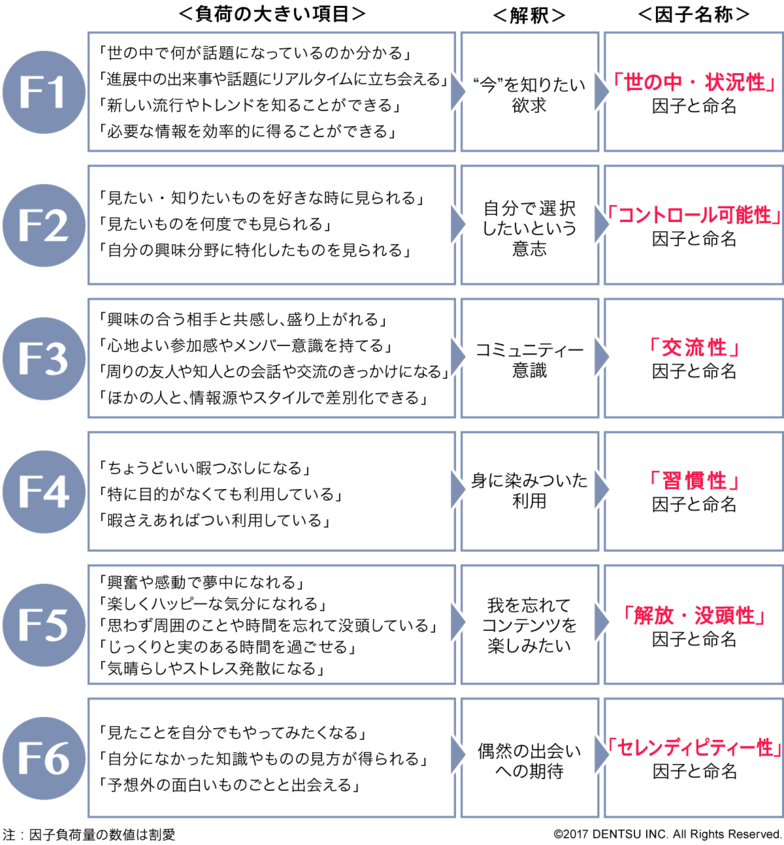
While familiar factors like "Social Context/Situational" and "Habitual" strongly evoke television viewing, the factor "Controllability" was also extracted, likely reinforced by online video streaming/sharing services. "Interactivity" appears closely related to SNS. Traditional media usage characteristics such as "Immersion/Escapism" and "Serendipity" also emerged.
Currently, the impressions consumers receive when using media can largely be summarized by these six factors.
The Attitude Change Effects of the Six Factors on Users
Let's examine the relationship between the six media usage characteristic factors and their attitude change effects (see Figure 3).
The values in the table indicate "the degree of influence each factor exerts on each attitude change effect." Red indicates a positive influence, while blue indicates a negative influence.
Figure 3: How Much Do Media Usage Characteristics Boost (or Lower) Attitude Change?
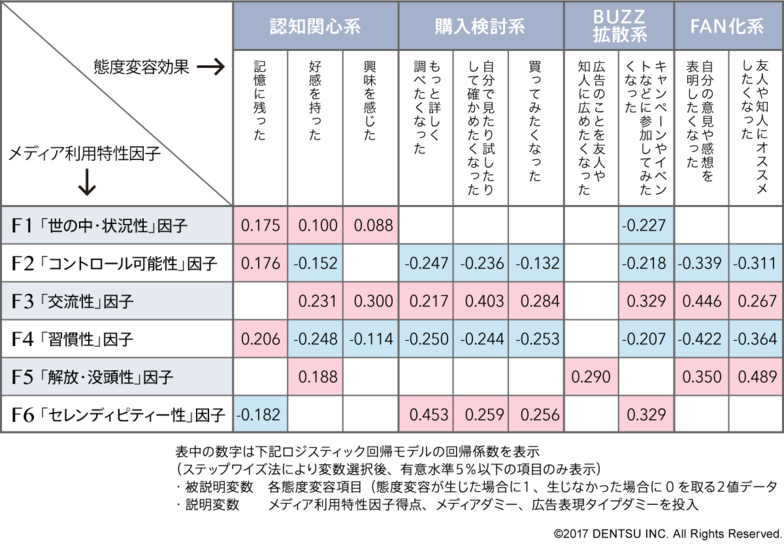
✓ The "Social Context" factor influences positive cognition
The "Social Context" factor shows a positive effect on overall attitude change within the cognitive interest system.
The characteristic desire for information, "wanting to understand the state of the world," associated with this factor likely means that advertisements are often perceived positively as "one form of information." Consequently, it is thought to have a favorable impact not only on memory but also on attitude change, such as favorability and interest.
Media with a strong presence of this factor can be considered advertising media where a "positive cognitive effect on the product" can be expected.
✓ The "Interactivity" factor is all-around
"Interactivity" positively contributes to all attitude changes except memory and BUZZ diffusion.
This factor is characterized by a sense of community among users. The information circulating is perceived, in a sense, as "conversation among peers," making it easy for even advertisements to be internalized as "personal matters." Consequently, it is presumed to positively influence a wide range of attitude changes.
Media strong in this factor can be considered advertising platforms with "all-around potential to address various challenges."
✓ Are the "Controllability" and "Habituality" factors limited to memory effects?
These two factors have a negative impact on nearly all attitude changes except memory.
"Controllability" indicates a high level of "purposefulness" during media contact. With this type of media use, even if the ad is remembered, it is thought to have the effect of causing aversion to unintended ad displays.
Conversely, "habituality" indicates a low level of purposefulness in viewing. Merely being exposed to the media makes it difficult for viewers to notice the displayed advertisements.
For media with strong influences of these two factors, it is advisable to consider using them solely for their memory effect or to implement measures to counteract the negative effects.
✓ The "Liberation/Immersion" factor deepens customer connections
"Liberation/Immersion" positively influences attitude change, particularly in BUZZ diffusion and FAN conversion.
When users are "immersed" in content, ads they like are consumed in a way similar to favorite content, making them more likely to want to share them with others (BUZZ diffusion). Furthermore, the feeling of being "liberated" is thought to have an effect that promotes FAN conversion by striking an emotional chord.
Media strong in this factor can be considered suitable advertising platforms for solving contemporary marketing challenges, such as generating buzz around ads and strengthening customer engagement.
✓ The "Serendipity Factor" is effective for sales promotion
"Serendipity" is characterized by its positive effect on changing attitudes related to purchase consideration. Incidentally, serendipity refers to "a wonderful chance encounter" or "an unexpected, delightful discovery."
When consumers engage with media while harboring "expectations for new discoveries relevant to themselves," they likely perceive advertising information in a mode of "Does this align with my own latent purchase consideration triggers?"
For media with a strong serendipity factor, advertising becomes a kind of "divine revelation," making it an excellent advertising medium for sales promotion support.
Understanding Media Characteristics Through Multiple Factor Combinations
The six media usage characteristic factors can positively or negatively influence user attitude change. Furthermore, each factor excels at different types of attitude change, revealing both strengths and weaknesses.
So, which media possess which factors? (See Figure 4)
Figure 4: Average Factor Scores by Media for Platform Image
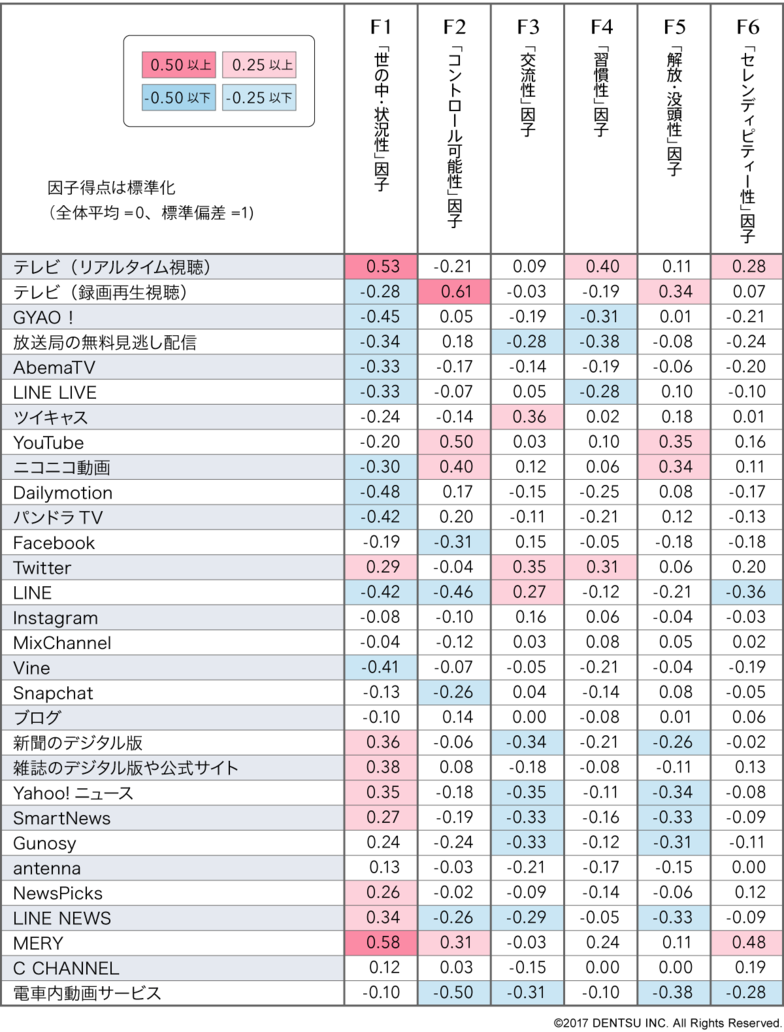
This table shows that each media has distinct strengths (or weaknesses) in these factors.
For example, we can see the following:
・ "Societal/Situational" is strong for TV (live viewing), Twitter, and news media
・ "Control" is strongfor TV (recorded viewing) and video sharing services
・ "Interactivity" is strong on SNS
・ "Habituality" is strongin TV (live viewing) and Twitter
・ "Liberation/Immersion" is strongwith TV (recorded playback viewing) and video sharing services
・ "Serendipity" is strong withTV (live viewing) and MERY
*MERY has made all articles private since December 7, 2016 (as of April 21, 2017).
The distinct strengths (or weaknesses) of these factors imply that different media excel at inducing different attitude changes. When selecting media for video ad placements, it seems crucial to assign roles based on each medium's factor characteristics.
Let's delve deeper using the "Media Usage Characteristics Factors." Here, we introduce an analysis that infers the "ideal" advertising media for specific marketing challenges based on combinations of particular factors.
We believe this provides a perspective for considering the marketing role of each medium.
Ideal Advertising Media ①: "One-Stop Sales Promotion Support Media"
If a media outlet possesses both strong "Societal/Situational" and "Serendipity" factors, it can be expected to function as a "One-Stop Sales Promotion Support Media," capable of driving a series of attitude shifts from awareness to purchase.
This could be considered the "ideal" advertising medium for promoting nearby goods.
Figure 5 shows a graph with these two factors on the vertical and horizontal axes.
Figure 5: Correlation of "Societal/Situational Context" and "Serendipity" Factors Across Media
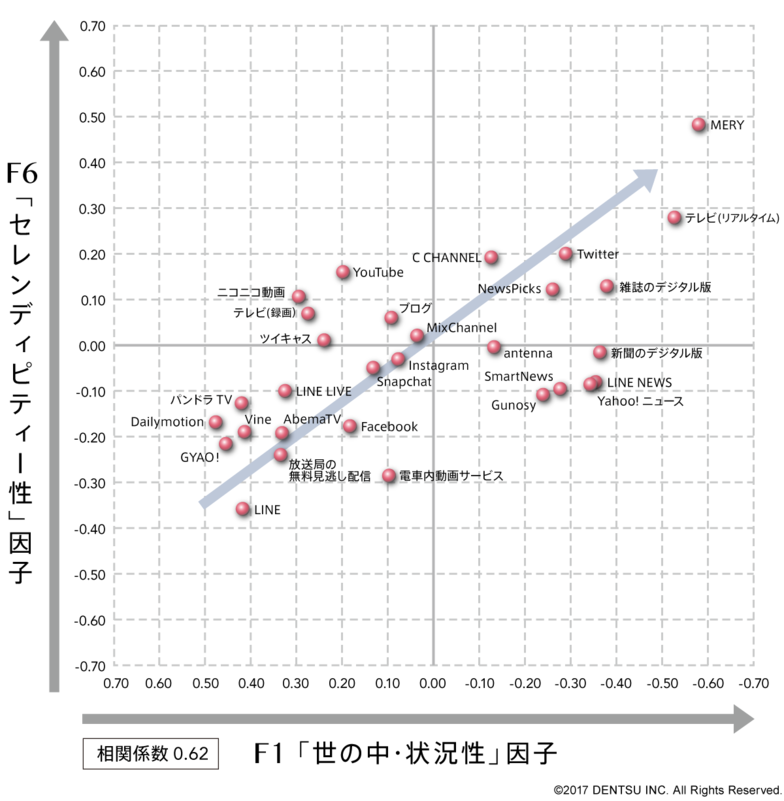
Media in the first quadrant (upper right of the graph) indicate strong "Social Context" and "Serendipity" factors.
Media such as "TV (real-time viewing)", "Twitter", "C CHANNEL", "MERY", "Digital Magazine Editions", and "NewsPicks" fall into this category, demonstrating the potential to serve as "one-stop sales promotion support media".
Furthermore, these two factors exhibit a positive correlation (correlation coefficient 0.62), indicating they can coexist naturally. The synergistic effect of both factors is believed to possess the power to smoothly shift the attitudes of people exposed to advertising from "awareness and interest" to "purchase consideration."
Ideal Advertising Medium ②: "All-Purpose Awareness-Building Advertising Medium"
If a media platform existed that combined "world/situational relevance" and "interactivity, " it could be expected to have a positive effect on all attitude changes except BUZZ diffusion, while maintaining a focus on awareness and consideration. In other words, it would possess the qualities of an "All-Purpose Awareness Advertising Media."
Wouldn't this be the "ideal" advertising medium capable of broadly addressing any advertiser's challenges?
For media possessing both factors, please refer to Figure 6.
Figure 6: Correlation of "Social Context" and "Interactivity" Factors Across Media
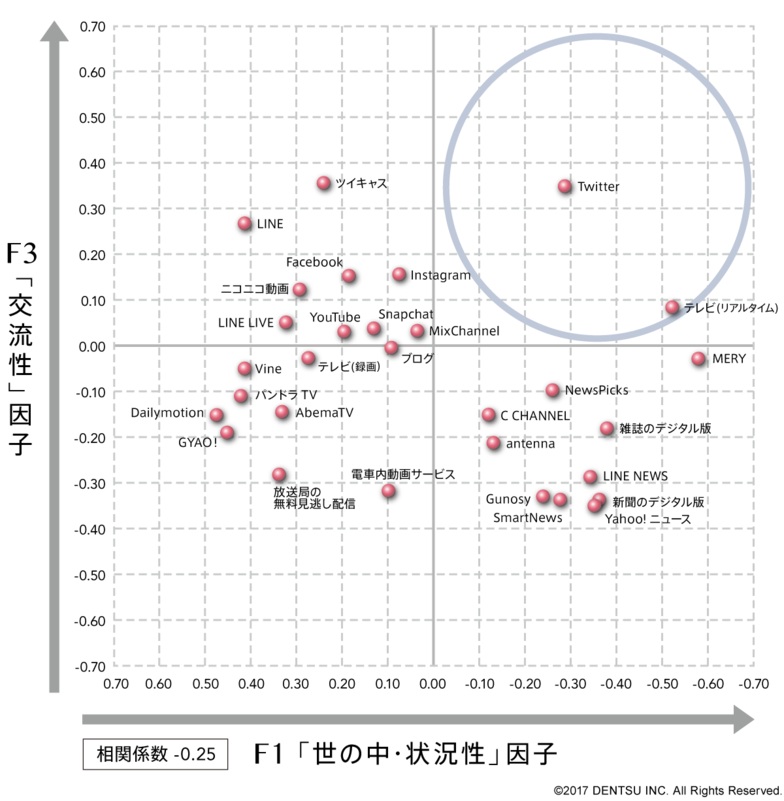
Let's examine the first quadrant here as well. It appears that only a limited number of media, such as "Twitter" and "TV (real-time viewing)," possess the potential to be "all-purpose advertising media for cognitive processes."
Furthermore, since both factors show a weak negative correlation (correlation coefficient -0.25), it is considered relatively difficult to realize a media service that elevates both "Interactivity" and "Societal/Situational Context." Twitter and TV (real-time viewing), which possess both factors, can be considered rare advertising media that are difficult to replace.
Finding the "Ideal" Advertising Media for Your Purpose Using the Same Approach
By combining and analyzing these "media usage characteristic factors," we can infer the "ideal" video advertising media tailored to specific advertising objectives.
While we've limited ourselves to two examples here, various other combinations seem possible.
For instance, if a medium combines "Social Context/Situational" and "Liberation/Immersion," it could positively impact both general attitude change (awareness/interest) and specific types like BUZZ diffusion and FAN conversion. Such a medium could be leveraged as a "Value Diffusion Advertising Medium," aiming not just for initial awareness through exposure but also for further diffusion to capture earned media. What kind of medium might this be? Explore Figure 4 to find out.
This study revealed the relationship between impressions during media use and attitude change effects, showing that even within video advertising media, various distinct characteristics exist.
For further marketing utilization of video advertising, rather than focusing solely on reach, shouldn't we assess the impact on attitude change effects arising from the differences in usage characteristics of each media? Based on this, we should determine the expected marketing role for that media.
Survey Overview: "Analysis of Usage Characteristics and Attitude Change in Video Advertising Media"
● Survey Period: October 2016
● Survey Method: Web-based survey
● Survey Participants: Men and women nationwide aged 15 (high school students and above) to 59
Participants used at least 7 of the surveyed media platforms "about once a week" or more.
● Sample Size: 3,000 survey responses collected; 2,301 samples analyzed (excluding repetitive responses)
【Contact】
Dentsu Inc. DENTSU SOKEN INC. Media Innovation Research Department
Shota Ogura
infomedia@dentsu.co.jp
Was this article helpful?
Share this article


Newsletter registration is here
We select and publish important news every day
For inquiries about this article
Back Numbers

Author

Naota Ogura
Dentsu Inc.
Future Scenario Consulting Department, 4th Marketing Bureau
General Manager (GM)
Insight MemoSmartphones: A Decade of Creative DestructionInfluencer Marketing 2.0Keywords for Predicting the FutureThe "Time Performance Era": How Should We Design Viewing Environments for Consumers?From "Reiwa: Survey on the Future Young People Want 2019" Hints for Reaching Young People Living in the Reiwa EraExploring Pathways from the "Quality of Society Survey" to a "Society" Where People Find Meaning in LifeCurrent State of Public Awareness and Values as Seen in the "Quality of Society Annual Survey 2021"

dentsu Media Innovation Lab
Dentsu Inc.
Insight MemoSpecial Discussion: "Japan's Advertising Expenditures"Explore the Amazing World of YouTube Creators with UUUMInformation Media White Paper 2024: The Rapidly Changing Media Environment and Consumers100 years since its birth. Radio, today...College Students and the Future of Media, Communication, and Advertising in Ten YearsInformation Media White Paper 2025: New Horizons in Communication Shaping the FutureInformation Media White Paper Special Report 2026: “The Current State of Evolving Information Trends”