Note: This website was automatically translated, so some terms or nuances may not be completely accurate.
 Insight Memo [53/65]
We investigated how much today's teens want to see video ads
Video advertising used to be almost synonymous with TV commercials. However, nowadays people encounter video ads on various platforms like YouTube, TVer, GYAO!, Facebook, and Yahoo!.
On the other hand, the display conditions for these video ads vary significantly across platforms, including the device used, the content, the duration, and whether they can be skipped. DENTSU SOKEN INC. conducted a "Video Ad Acceptance Survey" to investigate how these differing conditions influence people's desire to "want to watch" video ads, and to what extent, if at all.
The survey results provided several new insights. Here, we define those aged 15 to 19 as "TEEN" and focus on introducing the unique attitudes toward video ad acceptance that emerged among TEENs.

Under what conditions would you
and to what extent do they make people want to watch?
When video ads have various display conditions, conventional surveys struggle to measure their impact on the desire to watch. Therefore, we attempted to model video ad receptivity using conjoint analysis.
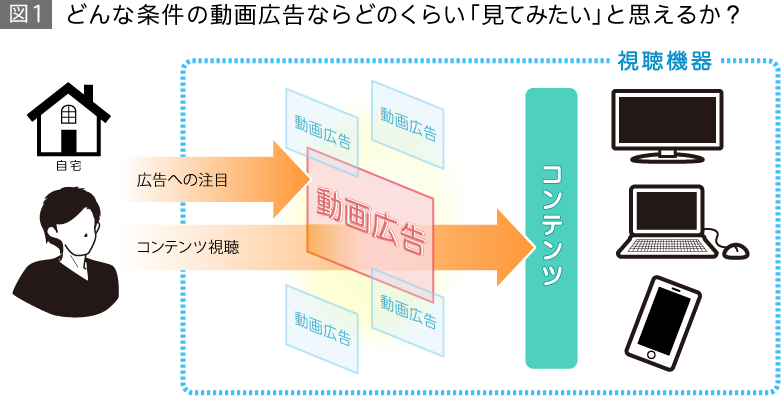
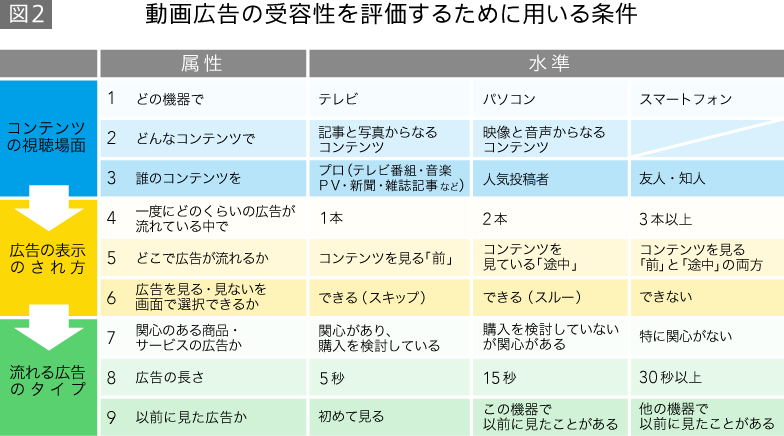
・Respondents rated on a 10-point scale how much they "want to watch" the video ad playing at that moment under various viewing conditions.
・By presenting participants with a fixed number of patterns defined by attributes and levels, the study measures how much each attribute and level influences the desire to "want to watch" the video ad.
Do teens dislike ads they can't skip?
Now, let's look at the survey results. [Figure 3] explains how much the viewing device affects the desire to "want to watch" an ad.
It plots the difference from an average of zero across all platforms, showing that values above zero boost the desire to watch, while those below reduce it. By comparing the overall average (gray) with males aged 15-19 (blue) and females aged 15-19 (pink), it highlights attitudes toward video ads characteristic of TEEN.
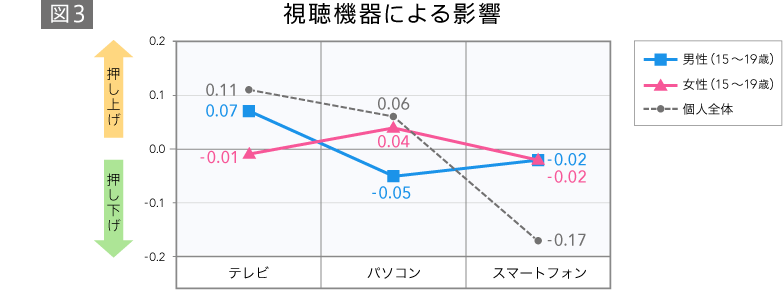
First, for the overall individual group, TV leads as the device where people most want to see ads, followed by PC and smartphone. Notably, smartphone viewing reduces the desire to see video ads by 0.17 points. This suggests that smartphone ad campaigns need some strategy to compensate for this relatively lower desire.
However, among male TEENs, smartphones do not lower this desire as much (-0.02 points). For female TEENs, PCs surpass TV, and smartphones are nearly on par with TV. Compared to the overall individual group, watching video ads on smartphones does not seem unnatural for TEENs. This reflects TEENs' strong attachment to smartphones.
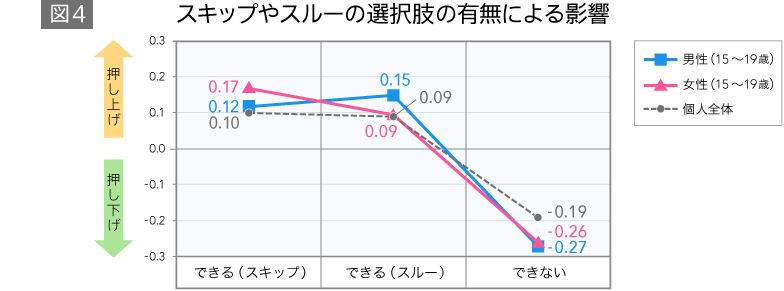
[Figure 4] shows the impact of having or lacking the option to view or skip ads on video ad viewing. For the general population, the "want to watch" sentiment decreased by 0.28 to 0.29 points when no option to skip or bypass ads existed, compared to when such an option was available. This trend was even stronger among TEENs, with decreases of 0.39 to 0.42 points for males and 0.35 to 0.43 points for females.
Generations familiar with skippable ads like YouTube's TrueView from an early age likely feel stressed by ads they cannot choose to avoid.
Teenage boys dislike ads during content viewing,
while females dislike ads interrupting their connections with friends.
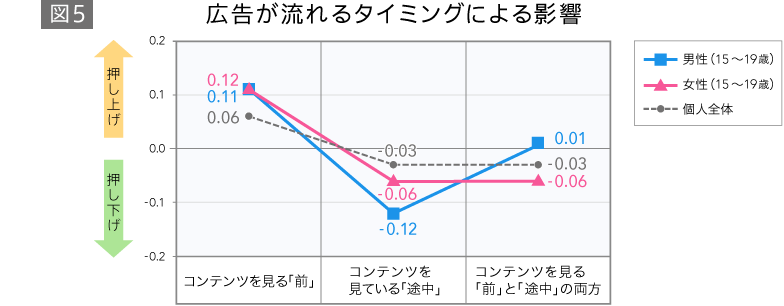
[Figure 5] shows the impact of when video ads appear. Overall, ads shown "before" content viewing boost the "want to watch" feeling by +0.09 points more than ads shown "during." Even when shown both "before" and "during," the rating is the same as for "during" ads.
However, for TEEN males, ads shown "during" content viewing were found to lower the desire to watch by -0.12 points. Overall, there is a preference for ads shown "before" content over "during," but TEEN males in particular seem to have a strong aversion to video ads during content viewing.
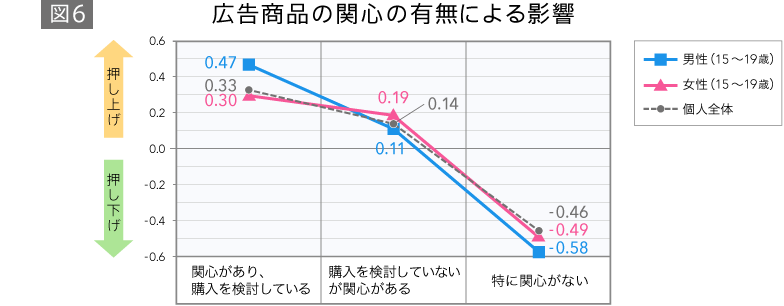
[Figure 6] shows the impact based on interest in the advertised product. Overall, for products where the viewer has "no particular interest," the desire to watch the ad is 0.79 points lower compared to ads for products they are "interested in" and "considering purchasing."
This reflects consumers' sensitivity to information usefulness. Among TEEN males, the decrease is even larger at 1.05 points. This suggests the younger generation's tendency toward selective information consumption—watching only what interests them and ignoring the rest.
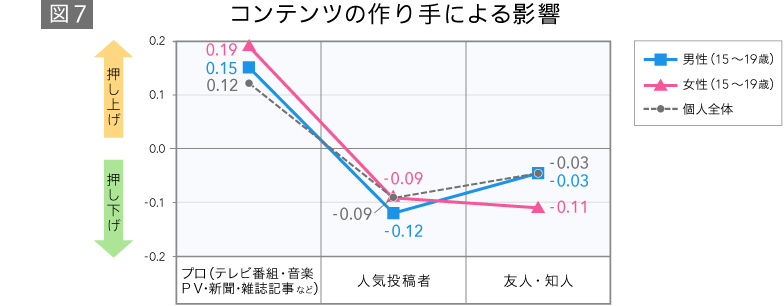
Figure 7 shows that the type of creator behind the content being viewed also influences the desire to watch ads displayed within that content. For the general population, "professional" content (TV programs, music videos, newspaper/magazine articles, etc.) increases the desire to watch displayed video ads by +0.12 points.
Conversely, when viewing content from "popular creators" on video-sharing services, it lowers the desire by -0.09 points, and when viewing content from "friends/acquaintances," it lowers it by -0.03 points. When watching content created by close friends or acquaintances, there seems to be a psychological aversion to being interrupted by ads.
On the other hand, since ads increase the desire to watch "professional" content, shouldn't these platforms be more highly valued as ad placements?
What's interesting is female TEENs. When it comes to "friends/acquaintances," their desire to watch drops the most, by -0.11 points. When companies try to reach them on social media, which is practically their lifeline, it seems they need to proceed with extreme caution.
Do teens want to choose video ads based on their mood?
While male and female characteristics differ, compared to the general population, TEENs reveal a somewhat very "self-centered" attitude toward video ads. The expansion of video platforms is fostering a new viewing style: enjoying desired content when, where, and how one feels like it.
For generations accustomed to television, the video ads (commercials) that aired there were, in a sense, something to be endured like pouring rain, or entities one was conditioned to watch. However, for the smartphone generation like TEEN, even advertisements are now seen as something they should choose to watch based on their mood.
Video ad campaigns that ignore this mindset may face unexpected pitfalls. As video advertising diversifies, the focus will likely shift beyond just exposure efficiency to understanding the video ad environments that resonate best with target audiences.
[Video Ad Acceptability Survey Overview]
● Survey Period: April 26, 2016
● Survey Method: Web-based survey
● Survey Participants: Men and women nationwide aged 10s to 50s who engaged in multiple days of the following four activities at home within one month (excluding those using each activity one day or less per month)
Watching TV (live broadcasts) / Watching TV (recorded playback) / Using a PC / Using a smartphone
●Sample Size: 2,400 survey responses collected; 2,117 samples analyzed (excluding single-pattern responses)
Was this article helpful?
Share this article


Newsletter registration is here
We select and publish important news every day
For inquiries about this article
Back Numbers


Author

Naota Ogura
Dentsu Inc.
Future Scenario Consulting Department, 4th Marketing Bureau
General Manager (GM)
Insight MemoSmartphones: A Decade of Creative DestructionInfluencer Marketing 2.0Keywords for Predicting the FutureThe "Time Performance Era": How Should We Design Viewing Environments for Consumers?From "Reiwa: Survey on the Future Young People Want 2019" Hints for Reaching Young People Living in the Reiwa EraExploring Pathways from the "Quality of Society Survey" to a "Society" Where People Find Meaning in LifeCurrent State of Public Awareness and Values as Seen in the "Quality of Society Annual Survey 2021"

dentsu Media Innovation Lab
Dentsu Inc.
Insight MemoSpecial Discussion: "Japan's Advertising Expenditures"Explore the Amazing World of YouTube Creators with UUUMInformation Media White Paper 2024: The Rapidly Changing Media Environment and Consumers100 years since its birth. Radio, today...College Students and the Future of Media, Communication, and Advertising in Ten YearsInformation Media White Paper 2025: New Horizons in Communication Shaping the FutureInformation Media White Paper Special Report 2026: “The Current State of Evolving Information Trends”