Note: This website was automatically translated, so some terms or nuances may not be completely accurate.
 The Future of Visual Communication with Dominique Chen [1/4]
Why Are Young People Obsessed with Photo Apps? Insights from Actual Usage Patterns

Dominique Chen

Akira Miwa
Dentsu Inc.

Toshiyuki Kitahara
Dentsu Inc.

Mariko Shitara
Dentsu Inc.

Akira Amano
The Media Innovation Research Department at DENTSU SOKEN INC. is a think tank whose mission is to explore changes in media and information communication environments, as well as audience trends.
This time, we invited IT entrepreneur and information studies researcher Dominic Chen as an advisor to conduct a research project themed around "visual communication" among smartphone users in their late teens to mid-twenties.
Within an ever-changing media environment, smartphone users' communication methods are also constantly evolving. Why are young people shifting toward visual-centric communication through photo and video apps?
We present a four-part discussion series unraveling the survey findings.
[Video] 7 Key Points of Visual Communication
[Survey Overview]
DENTSU SOKEN INC. Media Innovation Research Department
"Group Interview Survey on Visual Communication"
■Survey Participants
Men and women aged 18-25 residing in the Tokyo metropolitan area (university students or working adults)
N=17 (5 people × 2 groups + 7 people × 1 group)
■Survey Method
Group-based interview survey
■Survey Date
Sunday, September 6, 2015
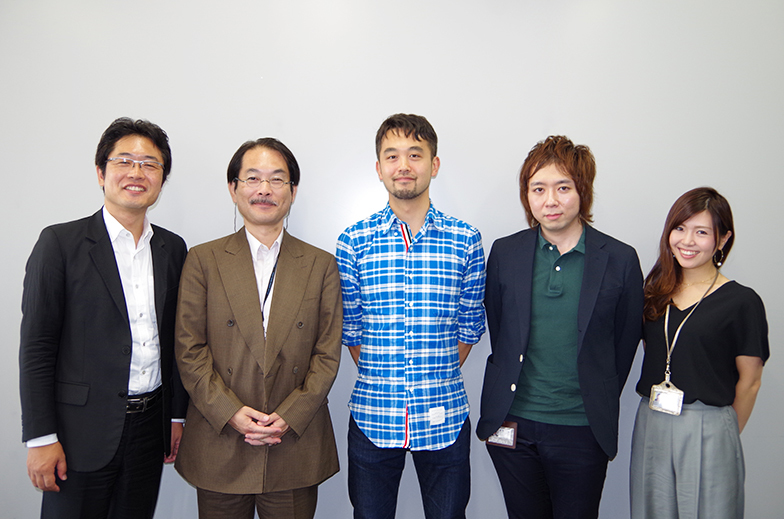
Dominique Chen (center) and, from left: Akira Miwa, Toshiyuki Kitahara, Akira Amano, and Mariko Shitara from DENTSU SOKEN INC. Media Innovation Research Department
Communication Trends Shift from Text to Visuals
Amano: In recent years, smartphone apps for handling photos and videos have become more sophisticated, and among many smartphone users, information activities utilizing visuals—such as viewing, taking, and sending photos and videos—have become firmly established.
We refer to this form of communication as "visual communication," contrasting it with literal communication based on text. We view it as a medium-to-long-term trend offering insights into future communication environments and have conducted extensive research and analysis on it.
Shitara: First, we illustrated the structure where users and information technology mutually interact to invigorate visual communication (Figure 1).
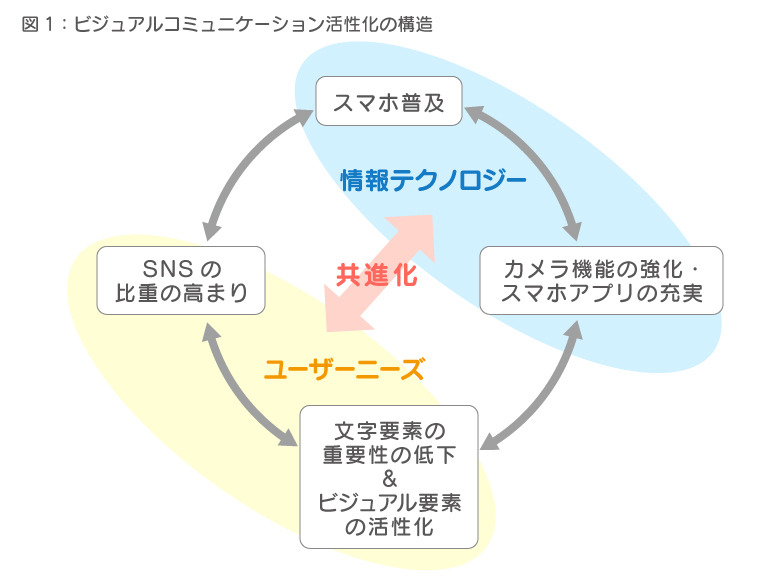
On the information technology side, there is the trend of smartphone proliferation and the enhancement of camera functions or applications. On the user side, there is the shift towards communicating visually rather than textually, coupled with the corresponding rise in the importance of SNS. These elements intertwine and co-evolve, driving the activation of visual communication.
Our findings show that when comparing the number of photo/video-related apps used or their usage frequency, women are more active than men, and this tendency becomes stronger among younger age groups. Young women are indeed the main drivers of this visual communication trend. They are sensitive to trends and engage in active information-seeking behavior centered around smartphones.
Dominique: It's interesting that gender differences emerge when comparing literal communication and visual communication. About two years ago, our company used online research tools to screen roughly 100,000 people and investigate smartphone photo usage. The results showed women overwhelmingly outnumbered men, and they took photos with their smartphones at least three days a week. Looking at these latest results, it seems this same trend continues.

Instagram, Twitter, Vine, Facebook, YouTube, Snapchat, MixChannel... Exploring how visual communication apps are differentiated
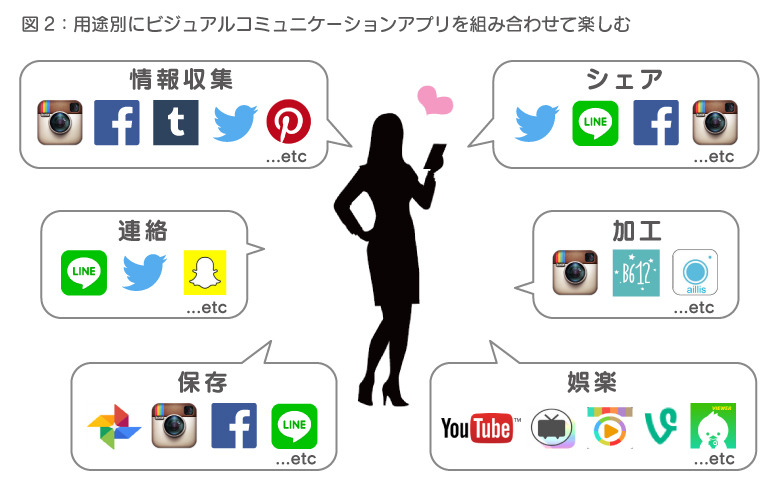
Kitahara: To briefly summarize the user interview results on how visual communication apps are differentiated: "sharing," "communication," "entertainment," "saving," etc... Even under the broad term "visual communication," there exists a wide range of uses tailored to specific needs.
By skillfully combining these, users are creating complex visual communication structures.
Shitara: Focusing on individual apps, Instagram was the most frequently used app in this user interview survey. Its positive characteristics can be summed up simply as being "stylish." There was also a preference for its "square format." Comments included "it has stylish posts" and "there's an admiration for people with a unified aesthetic."
Instagram also offers a closed environment for enjoyment, making it easy to post casually. This naturally increases posting frequency, and users often revisit their feed like flipping through an old photo album. Since photos are the main focus and visually engaging, it doesn't feel like a chore.
Miwa: Beyond that, people often use it like a magazine for trend references, or to gather recipe and restaurant info via hashtags. While they might check Tabelog or Google after searching a hashtag, the primary source of info is often from Instagram friends.
Shitara: On the flip side, some users avoid it because of the abundance of boastful photos. Instagram has this unspoken rule that emerged naturally among users: "Post nice-looking photos." Negative elements or anything uncool are taboo, so some people get "Instagram fatigue" from that overly stylish atmosphere.
There's also the "suggestive post" where a couple is clearly together, but only the man's hand is shown in the photo, just hinting at their presence.
Amano: It's become a space for sophisticated appeal or ostentatious display. This might reflect a trend where the stage for showing off has shifted from cities to social media.
Shitara: Besides Instagram, apps frequently used include Twitter, Vine, and Facebook. Even on platforms like Twitter and Facebook, which have been around longer, text elements are decreasing while the proportion of photo and video sharing is increasing.
Amano: The way we consume media—whether we view it vertically or horizontally on our smartphones—has also been getting attention lately.
I've heard comments like: square photos look cool on Instagram, short-form content like Vine is better viewed vertically, but watching a favorite artist's live performance slowly on YouTube is better horizontally.
Since video consumption often happens within the flow of social media or curated services, it's likely that people are increasingly watching in portrait mode as usual.
Shitara: Snapchat is an app that lets you post easily without leaving data traces or needing editing. Since it's popular mainly in the US, people with friends overseas seem to have opportunities to use it. On the other hand, it's still not widely recognized in Japan. We heard opinions that because few people around them use it, they don't understand how to use it or its benefits.
Dominique: Snapchat doesn't integrate with social media like Facebook, requiring email addresses or ID searches to add friends. However, there's also the issue that smartphone users rarely use email addresses these days. Expanding the user base is an area Picsee also aims to overcome.
Miwa: First- and second-year university students told me Snapchat and MixChannel are "used by generations younger than us." They also expressed discomfort with couple videos often posted on MixChannel. Here too, we can observe a generational gap. Teenagers, especially high school students, seem comfortable editing and sending videos, making self-expression through video quite common.
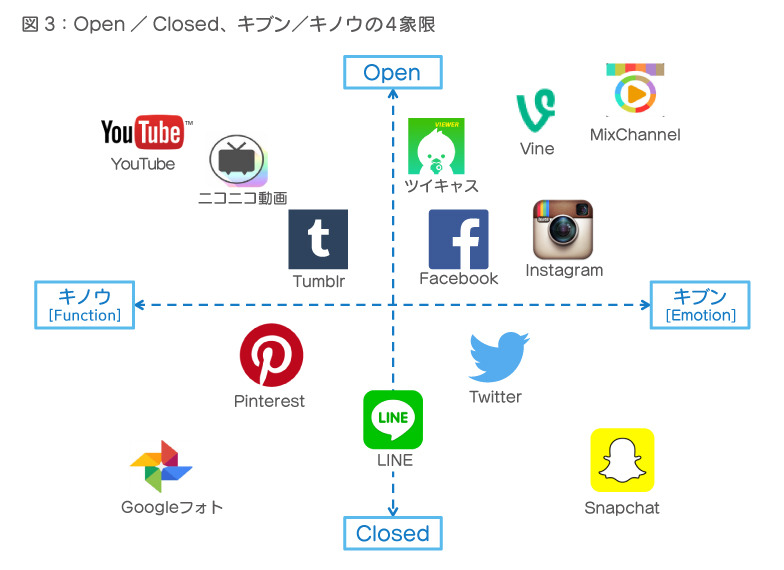
Shitara: Based on the usage patterns revealed by the survey, I thought we could perhaps categorize them by "function" and "mood."
Considering the axis of whether information sharing is broad and open to the general public or narrow and limited to acquaintances/friends (Open/Closed), and the axis of whether the purpose of use is Emotion or Function, I think we can arrive at the four quadrants shown in Figure 3.
Another characteristic is that Open apps tend to be primarily used for viewing, while Closed apps are primarily used for posting.
Looking at it this way, we see that many of the apps focused on in this survey fall into the Open and Emotion quadrant, indicating that users prioritizing sensory-focused visual communication tend to prefer them.
Kitahara: Additionally, regarding how to manage smartphone storage capacity, we observed that apps for "saving" are also frequently used. Users who effectively utilize apps like Google Photos understand the convenience of features like automatic uploads synced with their phone, tagging functionality, and the ability to create animated collages.
Amano: Photo organization and storage are pain points that have become more apparent precisely because we're in the visual communication era. Solutions are still being actively explored and developed.
Was this article helpful?
Share this article


Newsletter registration is here
We select and publish important news every day
For inquiries about this article
Author
Dominique Chen
Entrepreneur and researcher
Akira Miwa
Dentsu Inc.
Dentsu Inc. Media Innovation Lab
Director of Media Innovation Research
Insight MemoSmartphones and the JapaneseShiodome Media Researcher CommentaryThe Future of Visual Communication with Dominique ChenThe Future of Video ServicesSmartphones: A Decade of Creative DestructionMedia Behavior Data × Social Sequence AnalysisThe 30 Years of the Heisei Era: The Transformation and Innovation of Information MediaThe Reiwa "New" Era! Where is the Media Society Headed?
Toshiyuki Kitahara
Dentsu Inc.
Dentsu Inc. Media Innovation Lab
Principal Researcher
Articles by this person

What's the true intent behind the "Declaration to Quit Mass Media"? The current state of local media. Special Discussion: "Japan's Advertising Expenditures in 2024"

Analysis of "2023 Japan Advertising Expenditures"──The downgrade of COVID-19 to Category 5 provided tailwinds, setting a new record high. How did advertising expenditures change during the pandemic?
Mariko Shitara
Dentsu Inc.
Solution Development Center
Forecast Research Department, Principal Researcher